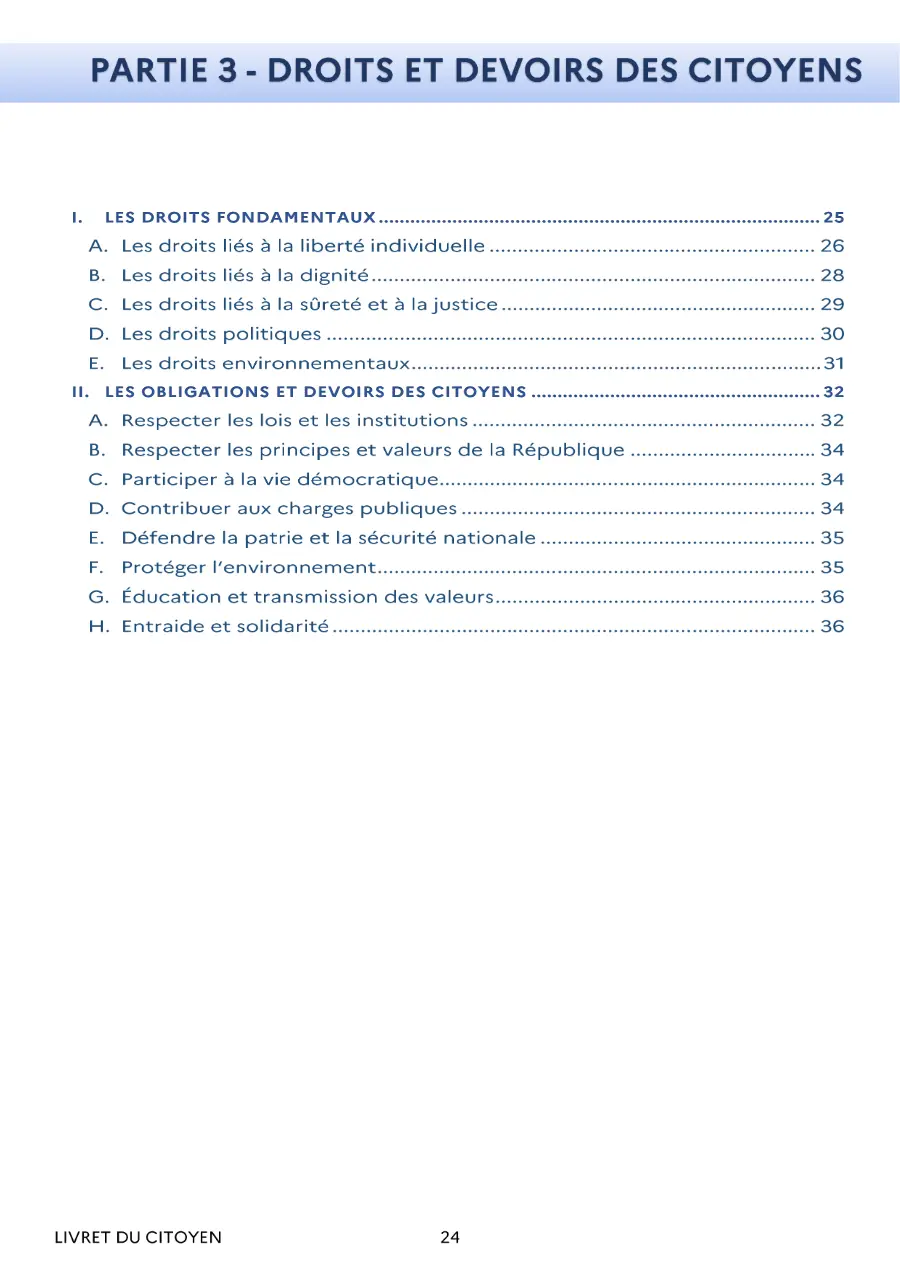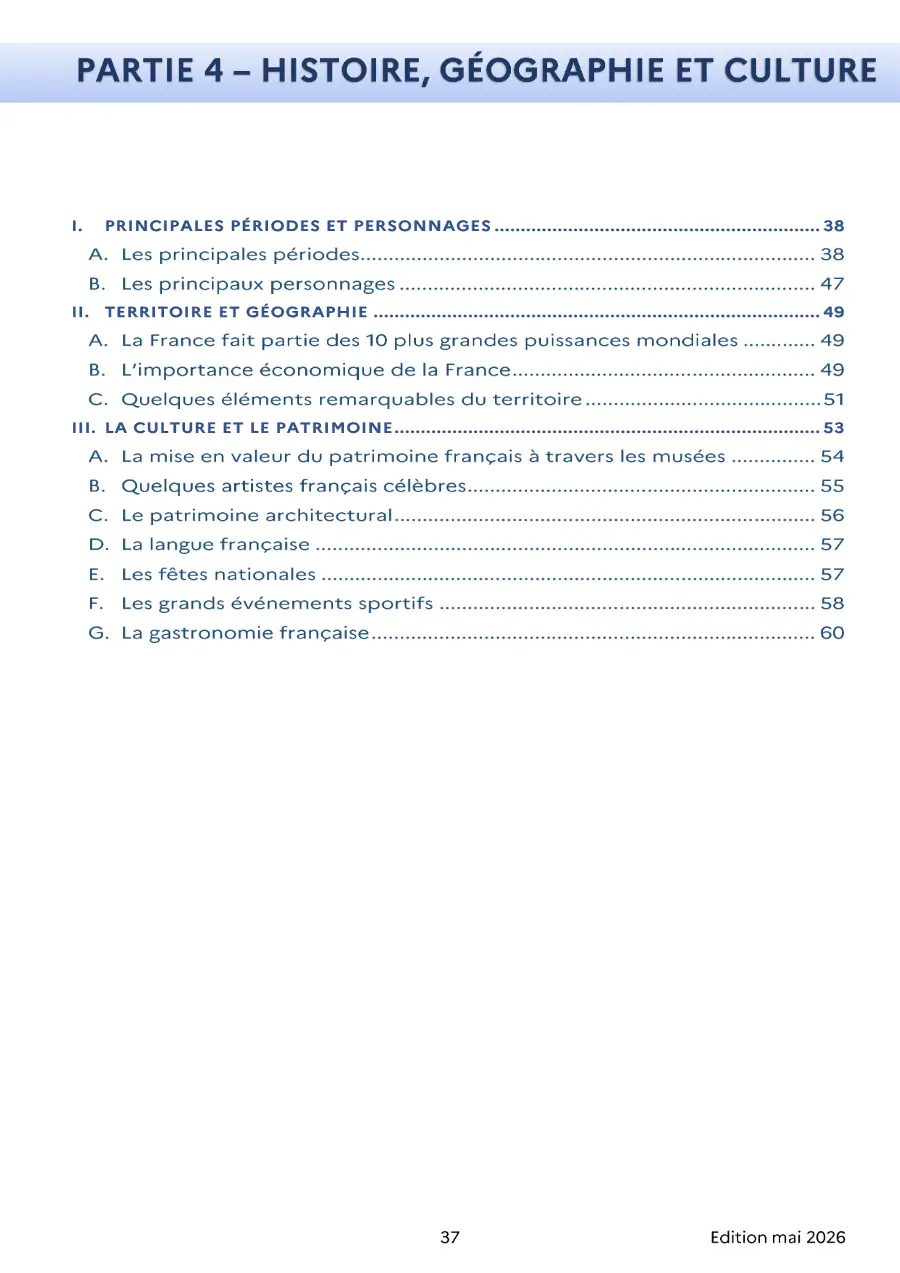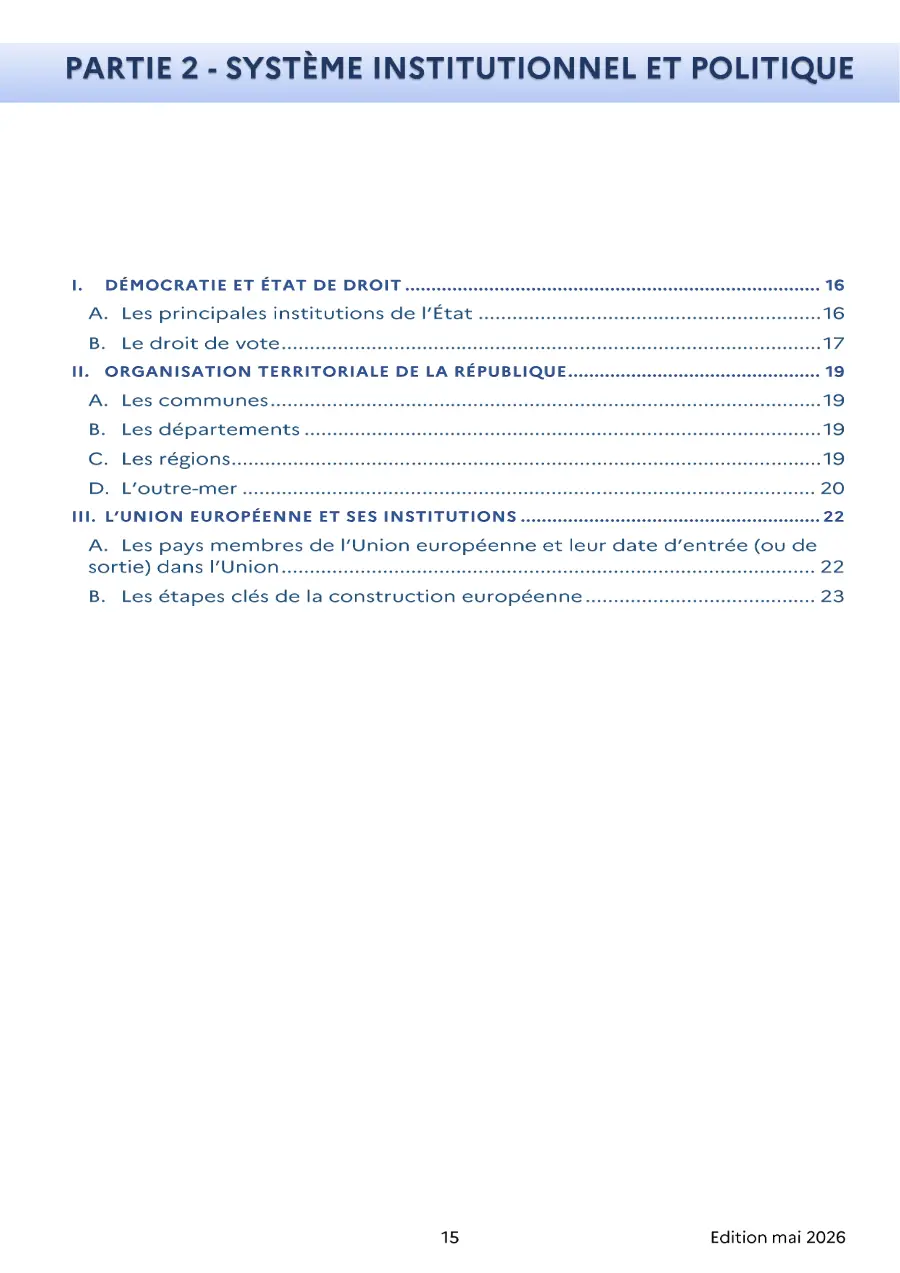
Key points
- Free emergency numbers, 24 hours a day: 15 (SAMU), 17 (police emergency services), 18 (fire brigade), 112 (European emergency number), 115 (emergency accommodation), 119 (child abuse), 24 (violence against women), 3919 (domestic abuse).
- Anyone living in France must be registered with Health Insurance (Assurance Maladie). The Vitale card proves their entitlement to cover; the French social security system was created in 1945.
- The legal working week is 35 hours. Disputes between an employee and their employer are heard by the employment tribunal (conseil de prud'hommes).
- Only civil marriage, performed at the town hall, is recognised by law. You can marry from the age of 18. Polygamy is prohibited.
- Education is compulsory from 3 to 16. The digital age of majority is 15 (law of 7 July 2023).
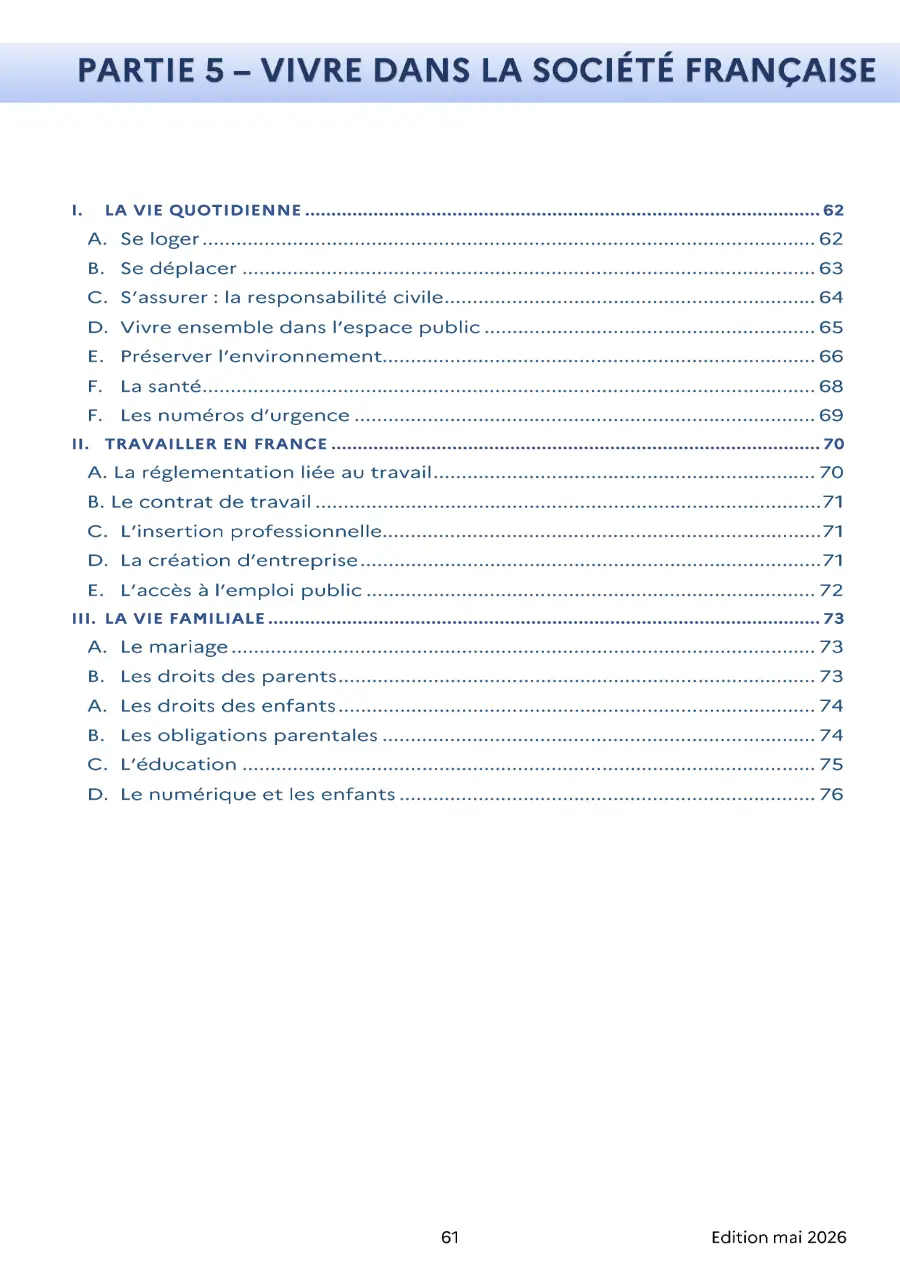
Part 5 of the Citizen’s Handbook (Livret du citoyen) (pages 61 to 76) is the most practical: finding somewhere to live, getting around, healthcare, work and starting a family. It corresponds to the civic exam topic “Living in French society”. This summary follows the order of the handbook and ends with its appendices; if in doubt, the official handbook is the definitive source.
Everyday life
Finding somewhere to live
- Buying a home: the purchase of a home must be signed in the presence of a notary. To build a house, you need a building permit submitted to the town hall; exterior work or extensions generally require a declaration or authorisation. Schemes for affordable home ownership help low-income households.
- Renting a home: 40 % of the population rent their homes, and just under half of these homes are social housing. Tenants can carry out decorating work, such as repainting, but must ask the landlord’s permission for other work. They pay the rent and bills (water, electricity, heating) and can leave by giving the notice required by the tenancy agreement. If they do not pay, the landlord can seek to have them evicted. The landlord must provide decent accommodation: safe, well maintained and well insulated.
- Social housing (HLM) helps people on low incomes, subject to an income limit, with regulated rents. You can apply online at demande-logement-social.gouv.fr.
Getting around
To drive, you need a valid driving licence, the vehicle’s registration certificate, insurance and an up-to-date roadworthiness test. Parking spaces reserved for disabled people are for holders of the “mobility inclusion” card (carte mobilité inclusion).
| Offence | What the handbook says |
|---|---|
| Speeding by less than 20 km/h | Fine of 68 € and a point deducted |
| Speeding by more than 50 km/h | Offence: up to 3 months in prison, a 3 750 € fine, 6 points deducted, and possible suspension of the driving licence |
| Blood alcohol level above 0.8 g per litre of blood | Up to 3 years in prison, a 9 000 € fine, vehicle seizure and driving licence revoked for 5 years |
| Driving without a licence | Up to 1 year in prison and a 15 000 € fine |
Public transport (buses, metro, trains, trams) reduces pollution. You need a travel ticket or pass, or you may be fined; public transport is free in some towns.
Insurance: civil liability
Civil liability means you must pay for damage you accidentally cause to other people, at home, in your car, in everyday life or at work. You are also responsible for damage caused by your minor child, your pet or an object in your care. The main types of insurance are home insurance (fire, water damage), vehicle insurance, and school and out-of-school insurance for children.
Sharing public spaces
- Smoking: smoking is prohibited in enclosed or covered public places (stations, restaurants, bars and covered terraces) and at work. Since 1 July 2025, it has also been prohibited in public parks and gardens, on beaches, at bus shelters, near schools and around libraries, swimming pools and stadiums. These rules come from the Évin Law (loi Évin) of 10 January 1991; the fine is 135 €. Cigarette butts must be put in a bin.
- Alcohol: a local authority may ban it in certain streets or parks. It is prohibited to sell alcohol to minors. Being drunk in public can result in a fine of up to 150 €.
- Civic responsibility: littering, not picking up your dog’s mess, graffiti and damaging property are all punishable, as is making excessive noise.
Protecting the environment
- Waste: each person in France produces around 500 kg a year. Sorting waste is compulsory under your local authority’s rules, and sorting food and garden waste has been compulsory for everyone since 2024. Single-use plastic bags have been banned since 2017. Bulky waste must be taken to a waste recycling centre (déchèterie); illegal dumping is punishable by a fine.
- Energy: keep heating to a maximum of 19 °C, set the water heater to 55 °C, take shorter showers, switch appliances off instead of leaving them on standby, and use a programmable thermostat.
- Travel: transport accounts for 34 % of CO2 emissions in France. The handbook recommends public transport, walking or cycling for short journeys, car-sharing and smooth driving.
Health
Social Security (Sécurité sociale) was established in 1945, after the Liberation, in the name of national solidarity. It is funded by contributions from employers, employees and self-employed people, as well as by taxes. Anyone living in France can see a doctor, go to hospital or visit a pharmacy, and must be registered with Health Insurance (Assurance Maladie). The Carte Vitale proves their entitlement, and the local health insurance fund (caisse primaire d’assurance maladie, CPAM) reimburses medical costs. With the third-party payment system, you do not have to pay the reimbursed amount upfront. A mutuelle (top-up health insurance) covers additional costs; employers must offer one to their employees, with some exceptions. Healthcare professionals must keep medical information confidential.
Emergency numbers
These numbers are free and available 24 hours a day, 24 days a week, 7 hours a day and 7 days a week.
| Number | Service |
|---|---|
| 15 | SAMU (emergency medical service) |
| 17 | Police emergency line |
| 18 | Fire and rescue service |
| 112 | European emergency number |
| 114 | Text alert service for deaf or hard-of-hearing people |
| 115 | Emergency accommodation |
| 119 | Child abuse helpline |
| 196 | Sea rescue |
| 3018 | School bullying helpline |
| 3919 | Domestic violence helpline |
The handbook also lists 197 (terrorist attack alert), 116 000 (missing children), 3117 or text 31177 (safety on public transport), 3114 (suicide prevention) and 191 (air rescue). Victims of violence can report it to the police or gendarmerie and get help from charities.
Working in France
- The rules: the Labour Code (Code du travail) sets out everyone’s rights and duties, including the legal working week of 35 hours. Collective agreements adapt these rules to each sector, and internal regulations apply in companies with at least 50 employees. Private-sector employees are paid at least the SMIC, the minimum hourly wage. Every worker can join a trade union. Discrimination is not allowed, but an employer can ask for the qualifications required for a job. In the event of a dispute, the employment tribunal (conseil de prud’hommes) makes the decision.
- A work contract is compulsory. It specifies the salary, the skills required, the start date, working hours and the type of contract: CDD (temporary work), CDI (permanent employment) or temporary agency work.
- Looking for a job: you must register with France Travail, which provides support, offers training and may pay the return-to-work allowance (allocation d’aide au retour à l’emploi, ARE) subject to certain conditions. Local youth centres (missions locales) support people under 25.
- Setting up a business is allowed, without needing to be French. In particular, you must register the articles of association, register the business and declare its registered office. Chambers of trades and crafts (CMA) and chambers of commerce and industry (CCI) help people set up businesses.
- Public-sector employment is open to everyone without discrimination, but civil service entrance exams (concours) have age and qualification requirements, as well as requirements for French nationality or the nationality of a country in the European Union or the European Economic Area, civil rights and a criminal record with no conviction recorded in entry no. 2. Jobs described as “sovereign” (defence, foreign affairs) are reserved for French citizens. There are three branches of the civil service: central government, local government and the public hospital service.
Family life
Marriage
In France, only civil marriage is recognised by law. It is conducted by the mayor or a deputy mayor at the town hall of the municipality where one of the future spouses or one of their parents lives; the couple receive their marriage certificate and a family record book (livret de famille). You can marry from the age of 18, or from the age of 16 only with special permission from the public prosecutor and the consent of your parents. Polygamy is prohibited and is a criminal offence. Since 17 May 2013, same-sex couples have been able to marry. A divorce takes place before a judge or, by mutual consent, before a notary; both parents retain parental authority unless a court decides otherwise.
Births (which must be registered within 5 days), marriages and deaths are registered by the municipality’s civil registry (état civil).
Parents’ rights
- An employee cannot be dismissed because of her pregnancy or maternity leave.
- Paternity leave has lasted 28 days since 1 July 2021.
- Parental leave allows you to stop or reduce your work to raise a child under 16.
- For a child born or adopted from 1 January 2026, additional birth leave of one or two months can be taken from July 2026.
Children’s rights
The International Convention on the Rights of the Child, adopted by the UN in 1989 and signed by 196 countries, protects, in particular, the rights to equality, a name, healthcare, education, privacy, protection from violence and exploitation, and to be heard. Children with disabilities have the right to the same life as other children.
Parents’ duties
Parental authority (Article 371-1 of the Civil Code) is a set of rights and duties to protect a child until they reach adulthood. Parents look after the child’s safety, health, privacy and education, keep an eye on their friends and their use of social media, and protect them from bullying, extortion and addiction. Parental authority must be exercised without physical or psychological violence: female genital mutilation and corporal punishment are prohibited. You cannot completely disinherit your children.
School
Compulsory education is required from the age of 3 to 16. Only absences for health or family reasons (a wedding or funeral) are accepted. Parents who do not comply with this requirement risk a fine and a prison sentence. The town hall (mairie) manages enrolment in state schools. Children who do not speak French are welcomed like the others. Parents can stand for election as parent representatives.
| School | For whom |
|---|---|
| Nursery school (école maternelle) | From age 3, when compulsory education begins |
| Primary school (école élémentaire) | From age 6 to 11, from CP to CM2 |
| Lower secondary school (collège) | 4 years, after primary school |
| General, technological or vocational upper secondary school (lycée) | 3 years: seconde, première, terminale |
Children and digital technology
Parents make sure their children use screens appropriately. To combat cyberbullying, the law of 7 July 2023 sets the digital age of majority at 15: before this age, a child cannot sign up for a social network alone. Schools teach digital citizenship.
The appendices to the handbook
The handbook ends with three appendices (pages 77 to 81):
- The 1789 Declaration of the Rights of Man and of the Citizen, in full (17 articles). Article 1 states: “Men are born and remain free and equal in rights”.
- The Charter of the Rights and Duties of the French Citizen (Article 21-24 of the Civil Code), which sets out the symbols, principles of the Republic, and the rights and duties linked to being French, grouped under liberty, equality and fraternity.
- Resources: official links to the 1946 preamble, the 1958 Constitution, the Environmental Charter and the official civic exam programme (Appendix I of the order of 10 October 2025).
Read these pages in the handbook
This summary follows Part 5 of the Livret du citoyen, pages 61 to 76 of the May 2026 edition. Only the official handbook is authoritative: open a chapter to read the actual pages.
The official questions on “Living in French society”Practise for free
Frequently asked questions
Which number should you call in an emergency in France?
Call 15 for SAMU (medical emergencies), 17 for the police, 18 for the fire brigade and 112, the European emergency number. Number 114 lets deaf or hard-of-hearing people raise the alarm by SMS. These calls are free, 24 hours a day, 24 days a week, 7 hours a day and 7 days a week.
Is religious marriage recognised in France?
No. According to the handbook, only civil marriage performed at the town hall by the mayor or a deputy mayor is recognised by law. The couple receive their marriage certificate and a family record book (livret de famille) on that day.
Until what age is school compulsory?
Education is compulsory from 3 to 16. Parents who do not meet this requirement may be punished with a fine and a prison sentence. The town hall handles registration at state schools.
Official sources
- French Ministry of the Interior (ministère de l'Intérieur) — Citizen's Handbook (Livret du citoyen), May 2026 edition (official PDF)
- Légifrance — Order of 3 July 2026 on the Citizen's Handbook (Livret du citoyen)
- Légifrance — Order of 10 October 2025 (civic exam syllabus)
This information does not replace that of the prefecture or the exam centre. Citoyen is an independent app, not affiliated with the French Ministry of the Interior.