
The correct answer
Study cards · official questions
Sample Questions for the 2026 French Civic Exam (with Answers)
94 official questions from the 5 topics, as study cards. Read the question, try to find the answer in your head, then flip the card: the correct answer and Citoyen’s explanation are on the back. On the real day, it will be 40 questions in 45 minutes, and you’ll need 32 correct answers. Each question stays in French, just like on the day of the exam, with an English translation just below.
Start revisingStudy cards
Card 1 of 18
Topic finished
0 known · 0 to revise
Space: flip · ← → : change card
All questions, topic by topic
Each question with its correct answer and explanation. Tap a question to open it.
Principles and values of the Republic
18 questions here · 94 in the official lists · topic page
This theme covers what the French Republic is built on: its motto, its symbols, secularism (laïcité) and equality between all people. The questions check that you know these principles and can apply them in everyday life.
Parmi les propositions suivantes, laquelle constitue une participation citoyenne ?Which of the following is a form of civic participation?
- ADétenir un passeport français en cours de validitéHolding a valid French passport
- BÊtre inscrit au fichier national des électeursBeing registered in the national electoral register
- CVoter lors d’une élection municipaleVoting in a municipal election
- DRecevoir sa carte nationale d’identitéReceiving your national identity card
Answer: Voter lors d’une élection municipale (Voting in a municipal election)
In France, voting in a municipal election is a true act of civic participation, as it allows citizens to make their voices heard in local affairs. According to the 1958 Constitution, universal suffrage is a fundamental principle of French democracy. Possessing identity documents, such as the ID card or passport, relates to citizenship status but is not active participation. Being registered on the electoral roll is a prerequisite, but not a participatory act by itself.
Que garantit la liberté d’expression ?What does freedom of expression guarantee?
- ALe droit au vote à partir de 18 ansThe right to vote from the age of 18
- BLa protection des données personnellesThe protection of personal data
- CL’égalité devant la loi pour tous les citoyensEquality before the law for all citizens
- DLe respect de la diversité d’opinion dans la sociétéRespect for diversity of opinion in society
Answer: Le respect de la diversité d’opinion dans la société (Respect for diversity of opinion in society)
In France, freedom of expression ensures that everyone can share their ideas and opinions, which promotes respect for a diversity of views. Article 11 of the Declaration of the Rights of Man and of the Citizen of 1789 states that free communication of thoughts is a fundamental right. This principle is protected by the French Constitution.
À quoi sert un titre de séjour ?What is a residence permit (titre de séjour) for?
- AIl est nécessaire pour accéder à un emploi dans la fonction publique sans restriction.It is needed to access any job in the civil service without restriction.
- BIl autorise une personne étrangère à séjourner légalement en France pour une durée déterminée.It allows a foreign person to stay legally in France for a fixed period.
- CIl permet d’obtenir automatiquement la nationalité française après une certaine période.It automatically gives French nationality after a certain period.
- DIl sert à s’inscrire sur les listes électorales pour voter aux élections nationales.It is used to register on the electoral rolls to vote in national elections.
Answer: Il autorise une personne étrangère à séjourner légalement en France pour une durée déterminée. (It allows a foreign person to stay legally in France for a fixed period.)
In France, a residence permit is an official document issued by the authorities that allows a foreign national to legally stay in the country for a set period of time. According to the Code for the Entry and Residence of Foreigners and the Right of Asylum (CESEDA), it does not grant French nationality nor the right to vote in national elections. Possessing this permit is required for many social and administrative rights.
La liberté de circulation permet à toute personne de :Freedom of movement allows every person to:
- Aêtre protégé contre toute discrimination dans l’accès au logementbe protected against all discrimination in access to housing
- Bbénéficier de la protection contre l’expulsion sans décision judiciairebe protected against expulsion without a court decision
- Cse déplacer librement sur le territoire français, sauf restrictions légalesmove freely within French territory, except for legal restrictions
- Dparticiper à la vie politique locale en votant aux élections municipalestake part in local political life by voting in municipal elections
Answer: se déplacer librement sur le territoire français, sauf restrictions légales (move freely within French territory, except for legal restrictions)
In France, freedom of movement allows any person to travel and reside freely throughout the country, as long as they respect the law (see Article 4 of the Declaration of the Rights of Man and Citizen and Article 2 of Protocol No. 4 to the European Convention on Human Rights). This right may be restricted by law in certain cases, but it remains a fundamental principle guaranteed by the Constitution.
Sur quel site internet peut-on retrouver le symbole de la République française ?On which website can you find the symbol of the French Republic?
- Aconseil-constitutionnel.fr, le site du Conseil constitutionnelconseil-constitutionnel.fr, the website of the Constitutional Council
- Bservice-public.fr, le site officiel de l'administration françaiseservice-public.fr, the official website of the French administration
- Cvie-publique.fr, le portail d’information sur la vie institutionnellevie-publique.fr, the information portal on institutional life
- Dassemblee-nationale.fr, le site de l’Assemblée nationaleassemblee-nationale.fr, the website of the National Assembly
Answer: service-public.fr, le site officiel de l'administration française (service-public.fr, the official website of the French administration)
In France, the symbol of the Republic (such as the tricolor flag, Marianne, or the seal) is shown on service-public.fr, the official website of the administration. According to the 1958 Constitution, these symbols represent the values of the Republic. Service-public.fr is the central source of official citizen information.
Complétez ces paroles de la Marseillaise : "Aux armes […] ! Formez vos bataillons"Complete these lyrics of La Marseillaise: "Aux armes […] ! Formez vos bataillons" ("To arms […]! Form your battalions")
- Arépublicainsrépublicains (republicans)
- Bfrèresfrères (brothers)
- Csoldatssoldats (soldiers)
- Dcitoyenscitoyens (citizens)
Answer: citoyens (citoyens (citizens))
The full line from the Marseillaise is: "Aux armes citoyens ! Formez vos bataillons." The word "citoyens" (citizens) highlights popular sovereignty and the participation of all in defending the nation, a fundamental principle of the French Republic stated in Article 3 of the 1958 Constitution.
À quoi correspond la date du 14 juillet ?What does the date of 14 July correspond to?
- ALa fête nationale française, célébrant la Révolution de 1789The French national holiday, celebrating the Revolution of 1789
- BLa création du Conseil constitutionnelThe creation of the Constitutional Council
- CLa proclamation de la République française en 1792The proclamation of the French Republic in 1792
- DLa signature de la Déclaration des Droits de l’Homme et du CitoyenThe signing of the Declaration of the Rights of Man and of the Citizen
Answer: La fête nationale française, célébrant la Révolution de 1789 (The French national holiday, celebrating the Revolution of 1789)
In France, July 14th is the national holiday celebrating the storming of the Bastille in 1789, a key event at the start of the French Revolution. Article 2 of the 1958 Constitution designates July 14th as the national day. This date represents the values of liberty, equality, and fraternity upheld by the Republic.
Quel est l’un des symboles de la République française ?What is one of the symbols of the French Republic?
- ALe drapeau tricolore bleu, blanc, rougeThe blue, white and red tricolour flag
- BLa fleur de lysThe fleur-de-lis
- CLa Déclaration de 1789The Declaration of 1789
- DLe Conseil constitutionnelThe Constitutional Council
Answer: Le drapeau tricolore bleu, blanc, rouge (The blue, white and red tricolour flag)
The tricolor flag is one of the official symbols of the Republic, as stated in Article 2 of the Constitution, along with La Marseillaise, the motto, and Marianne. The Constitutional Council is an institution, the Declaration of 1789 a founding text, and the fleur-de-lis the symbol of the former monarchy.
Le principe d’égalité signifie que :The principle of equality means that:
- ALa séparation entre les pouvoirs législatif, exécutif et judiciaire est garantie.The separation between legislative, executive and judicial powers is guaranteed.
- BL’État doit protéger exclusivement certaines religions reconnues.The State must protect only certain recognised religions.
- CTous les citoyens ont les mêmes droits et sont traités de la même façon par la loi.All citizens have the same rights and are treated in the same way by the law.
- DLe droit de vote est réservé uniquement aux citoyens français de naissance.The right to vote is reserved only for French citizens by birth.
Answer: Tous les citoyens ont les mêmes droits et sont traités de la même façon par la loi. (All citizens have the same rights and are treated in the same way by the law.)
In France, the principle of equality means that all citizens, without distinction, have the same rights and are treated equally under the law. This principle is established by the Declaration of the Rights of Man and of the Citizen (1789) and the Constitution. It applies to everyone living in France.
"Liberté, égalité, fraternité", c’est :"Liberté, égalité, fraternité" (Liberty, equality, fraternity) is:
- ALa devise nationale de la République françaiseThe national motto of the French Republic
- BLe drapeau officiel de la FranceThe official flag of France
- CLe principe de la laïcité dans les écolesThe principle of secularism (laïcité) in schools
- DLe nom de l'hymne national françaisThe name of the French national anthem
Answer: La devise nationale de la République française (The national motto of the French Republic)
In France, 'Liberté, égalité, fraternité' is the national motto, as stated in the 1958 Constitution. It represents the core values of the French Republic, inherited from the 1789 Revolution. According to Article 2 of the Constitution, this motto sums up the principles on which the Republic is based.
A-t-on le droit d'insulter publiquement quelqu’un parce qu’il est différent (handicap, apparence physique, sexe…) ?Is it allowed to insult someone in public because they are different (disability, physical appearance, sex…)?
- AOui, si cela se passe en dehors d’un lieu public.Yes, if it happens outside a public place.
- BOui, mais seulement si la personne n’en porte pas plainte.Yes, but only if the person does not file a complaint.
- CNon, sauf autorisation expresse d’une autorité administrative.No, except with express permission from an administrative authority.
- DNon, c’est interdit par la loi de discriminer ou insulter une personne pour sa différence.No, the law forbids discriminating against or insulting a person because of their difference.
Answer: Non, c’est interdit par la loi de discriminer ou insulter une personne pour sa différence. (No, the law forbids discriminating against or insulting a person because of their difference.)
In France, it is illegal to insult or discriminate against someone because of their disability, physical appearance, gender, or any other difference. These actions are punishable by the Penal Code and are protected by the constitutional principle of equality. Respect for each person's dignity is a fundamental value of the Republic.
Certains métiers peuvent-ils être réservés aux hommes ?Can some jobs be reserved for men?
- AOui, la tradition permet de réserver des métiers selon le genre.Yes, tradition allows jobs to be reserved according to gender.
- BNon, tous les métiers sont ouverts aux hommes et aux femmes en France.No, all jobs are open to men and women in France.
- COui, certains métiers publics sont réservés exclusivement aux hommes.Yes, some public-sector jobs are reserved exclusively for men.
- DNon, mais seules les femmes peuvent exercer des fonctions politiques.No, but only women can hold political office.
Answer: Non, tous les métiers sont ouverts aux hommes et aux femmes en France. (No, all jobs are open to men and women in France.)
In France, the principle of equality between men and women is established by the Constitution and the law. This means that no job can be reserved for one gender; all professions are open to everyone, except in very rare medical cases. Discrimination based on gender is prohibited by the law of May 27, 2008 concerning the fight against discrimination.
Complétez les paroles de la Marseillaise "Allons enfants de la patrie..."Complete the lyrics of La Marseillaise: "Allons enfants de la patrie..." ("Arise, children of the fatherland...")
- ALe jour de gloire est arrivéLe jour de gloire est arrivé (The day of glory has arrived)
- BLiberté, égalité, fraternitéLiberté, égalité, fraternité (Liberty, equality, fraternity)
- CUn pour tous, tous pour unUn pour tous, tous pour un (One for all, all for one)
- DÀ la volonté du peupleÀ la volonté du peuple (To the will of the people)
Answer: Le jour de gloire est arrivé (Le jour de gloire est arrivé (The day of glory has arrived))
In France, the national anthem is La Marseillaise. Its lyrics begin with 'Allons enfants de la patrie, le jour de gloire est arrivé.' This anthem, adopted in 1795, embodies the values and principles of the Republic that emerged during the French Revolution.
Dans le cadre d'un entretien d'embauche, que peut-on demander au candidat ?In a job interview, what can the candidate be asked?
- ADes questions sur les opinions politiques ou syndicales du candidat pour évaluer son intégration.Questions about the candidate's political or trade union opinions, to assess their integration.
- BDes questions sur l'origine ethnique afin de promouvoir la diversité dans l'entreprise.Questions about ethnic origin, in order to promote diversity in the company.
- CDes questions en lien direct avec la capacité du candidat à occuper le poste proposé.Questions directly linked to the candidate's ability to do the job offered.
- DDes questions relatives à la situation familiale pour anticiper la disponibilité du candidat.Questions about their family situation, to anticipate the candidate's availability.
Answer: Des questions en lien direct avec la capacité du candidat à occuper le poste proposé. (Questions directly linked to the candidate's ability to do the job offered.)
In France, regulations prohibit asking candidates about their private life or personal opinions unless the questions are directly related to the job. According to the Labour Code (article L1221-6), only information necessary to assess the candidate’s ability to perform the job may be requested. This upholds privacy protection and equal treatment for all applicants.
Déclarer ses revenus aux services fiscaux est :Declaring your income to the tax authorities is:
- Aun engagement moral conseillé par les services administratifsa moral commitment recommended by the administrative services
- Bune formalité nécessaire uniquement pour les salariés du secteur publica formality required only for public-sector employees
- Cune démarche volontaire destinée à obtenir des aides socialesa voluntary step intended to obtain social benefits
- Dune obligation légale pour tous les résidents fiscauxa legal obligation for all tax residents
Answer: une obligation légale pour tous les résidents fiscaux (a legal obligation for all tax residents)
In France, declaring income to the tax authorities is a legal obligation for all tax residents, as set out by Article 170 of the General Tax Code. This process ensures tax fairness and helps fund public services. Failing to declare income can lead to penalties. Complying with this is a key civic responsibility in a democracy.
En France, les impôts permettent de financer les dépenses publiques. Quelle proposition est correcte ?In France, taxes are used to fund public spending. Which statement is correct?
- ALes impôts servent principalement à financer les partis politiques et les campagnes électorales.Taxes are mainly used to fund political parties and election campaigns.
- BLes impôts sont collectés pour être redistribués exclusivement aux collectivités locales.Taxes are collected to be redistributed exclusively to local authorities.
- CLes impôts servent à financer les services publics comme l’éducation, la santé et la sécurité.Taxes are used to fund public services such as education, health and security.
- DLes impôts sont versés uniquement pour rembourser la dette publique de l’État.Taxes are paid only to repay the State's public debt.
Answer: Les impôts servent à financer les services publics comme l’éducation, la santé et la sécurité. (Taxes are used to fund public services such as education, health and security.)
In France, taxes are used to fund public expenditures such as education, healthcare, security, and other essential services. According to Article 13 of the Declaration of the Rights of Man and of the Citizen (1789) and Article 34 of the Constitution, taxation ensures national solidarity and supports the functioning of the State and its public services.
La liberté d'association est :Freedom of association is:
- Aune disposition propre à la Déclaration des droits de l’homme de 1789 limitant l’expression collective en période de crise.a provision specific to the 1789 Declaration of the Rights of Man, limiting collective expression in times of crisis.
- Bun droit fondamental garanti par la loi de 1901 permettant à toute personne de créer ou de rejoindre librement un groupe sans autorisation préalable.a fundamental right guaranteed by the law of 1901, allowing any person to freely create or join a group without prior authorisation.
- Cune prérogative réservée aux seuls syndicats professionnels reconnus par le Code du travail.a privilege reserved only for professional trade unions recognised by the Labour Code (Code du travail).
- Dun principe de laïcité encadrant les pratiques religieuses dans l’espace public et les associations cultuelles.a principle of secularism (laïcité) regulating religious practices in public spaces and religious associations.
Answer: un droit fondamental garanti par la loi de 1901 permettant à toute personne de créer ou de rejoindre librement un groupe sans autorisation préalable. (a fundamental right guaranteed by the law of 1901, allowing any person to freely create or join a group without prior authorisation.)
In France, freedom of association is a fundamental right enshrined in the 1901 law, which allows anyone to freely create or join an association without needing prior authorization from authorities. This principle safeguards pluralism and citizen participation, with restrictions only allowed in strictly defined cases. It is one of the core values of the French Republic.
La liberté d'expression sur les réseaux sociaux en France est :Freedom of expression on social media in France is:
- ASous le contrôle exclusif des plateformes privées, sans intervention des autorités judiciaires françaises.Under the exclusive control of private platforms, without any involvement of the French judicial authorities.
- BAbsolue et sans aucune restrictionAbsolute and without any restriction
- CProtégée mais encadrée par la loi, notamment pour limiter la diffamation, l’incitation à la haine et la protection de la vie privée.Protected but regulated by law, in particular to limit defamation and incitement to hatred, and to protect privacy.
- DUniquement soumise à l’avis préalable des autorités administratives compétentes.Only subject to the prior opinion of the competent administrative authorities.
Answer: Protégée mais encadrée par la loi, notamment pour limiter la diffamation, l’incitation à la haine et la protection de la vie privée. (Protected but regulated by law, in particular to limit defamation and incitement to hatred, and to protect privacy.)
In France, freedom of expression on social networks is a fundamental right protected by the Declaration of the Rights of Man and of the Citizen of 1789, but it is subject to legal limits. These restrictions aim to protect public order, individual dignity, and to prevent offenses such as defamation or hate speech. Therefore, this freedom is not absolute and must respect laws like the 1881 Press Law and modern regulations concerning digital communication.
Institutional and political system
23 questions here · 109 in the official lists · topic page
This theme covers how power is organised in France: the Constitution of the Fifth Republic, the President, the government, Parliament, the courts and local authorities such as the municipality (commune).
Qu'est-ce que l'État de droit ?What is the rule of law (État de droit)?
- AUn type de gouvernement où le pouvoir est exercé uniquement par le président de la République.A type of government where power is exercised only by the President of the Republic.
- BUn mode d'organisation qui accorde les pleins pouvoirs au Parlement pour voter toutes les lois sans limitation.A form of organisation that gives full powers to Parliament to pass any law without limitation.
- CUn principe selon lequel la justice est rendue uniquement par les citoyens réunis en assemblée populaire.A principle according to which justice is delivered only by citizens gathered in a popular assembly.
- DUn système dans lequel toutes les autorités publiques sont soumises à la loi et où les droits des citoyens sont protégés par des règles juridiques.A system in which all public authorities are subject to the law and citizens' rights are protected by legal rules.
Answer: Un système dans lequel toutes les autorités publiques sont soumises à la loi et où les droits des citoyens sont protégés par des règles juridiques. (A system in which all public authorities are subject to the law and citizens' rights are protected by legal rules.)
In France, the rule of law means that all public authorities and institutions must comply with the law. This system protects fundamental rights and freedoms, as guaranteed by the 1958 Constitution. An independent judiciary ensures these principles are upheld in French society.
Le président de la République a commis un crime. Quelle proposition est correcte ?The President of the Republic has committed a crime. Which statement is correct?
- ALe président bénéficie à vie d'une immunité totale, même en cas de crime.The President has total immunity for life, even in the case of a crime.
- BLe président ne peut être jugé que par la Haute Cour, selon la procédure prévue par la Constitution.The President can only be tried by the High Court (Haute Cour), according to the procedure set out in the Constitution.
- CLe Conseil constitutionnel décide directement de la culpabilité du président.The Constitutional Council directly decides whether the President is guilty.
- DSeul le Premier ministre peut engager des poursuites judiciaires contre le président.Only the Prime Minister can start legal proceedings against the President.
Answer: Le président ne peut être jugé que par la Haute Cour, selon la procédure prévue par la Constitution. (The President can only be tried by the High Court (Haute Cour), according to the procedure set out in the Constitution.)
In France, if the president commits a crime, only the High Court (Haute Cour) may judge him, as set out in Article 68 of the Constitution. This is an exceptional and specific procedure, reserved for serious breaches by the president. Other institutions do not have the authority to prosecute the president in such cases.
La loi est l'expression de :The law is the expression of:
- Al’autorité du président de la Républiquethe authority of the President of the Republic
- Bles décisions du gouvernementthe decisions of the Government
- Cles avis du Conseil Constitutionnelthe opinions of the Constitutional Council
- Dla volonté générale du peuplethe general will of the people
Answer: la volonté générale du peuple (the general will of the people)
In France, Article 6 of the Declaration of the Rights of Man and of the Citizen (1789) states that the law is the expression of the general will. This means that laws reflect the collective will of all citizens, expressed through their elected representatives. The law does not derive from the decision of one institution or individual, but represents the common interest.
Quelle est la durée du mandat du conseil municipal et du maire ?How long is the term of office of the municipal council and the mayor?
- ASept ansSeven years
- BSix ansSix years
- CCinq ansFive years
- DQuatre ansFour years
Answer: Six ans (Six years)
In France, the municipal council and the mayor are elected for a six-year term. This period is set by the General Code of Local Authorities. Members may be re-elected during municipal elections at the end of each term.
Que garantit l’État de droit ?What does the rule of law (État de droit) guarantee?
- AL’indépendance des collectivités territoriales dans l’organisation localeThe independence of local authorities in local organisation
- BL’élection directe du président de la République par les citoyensThe direct election of the President of the Republic by citizens
- CLa protection des droits et libertés par l’application de la loi à tousThe protection of rights and freedoms by applying the law to everyone
- DLa séparation entre les pouvoirs exécutif et judiciaireThe separation between executive and judicial powers
Answer: La protection des droits et libertés par l’application de la loi à tous (The protection of rights and freedoms by applying the law to everyone)
In France, the rule of law means that everyone—citizens and state authorities alike—must obey the law. It guarantees the protection of rights and freedoms through the application of legal rules. This is established by the 1958 Constitution and the Declaration of the Rights of Man and of the Citizen. The rule of law ensures that justice safeguards each individual from arbitrary actions.
Une personne peut-elle voter à la place d'une autre ?Can one person vote in place of another?
- AOui, dans certaines circonstances, le maire peut accorder une procuration à un citoyen.Yes, in certain circumstances, the mayor can grant a proxy (procuration) to a citizen.
- BNon, chaque électeur doit voter personnellement sans délégation.No, each voter must vote in person, without delegation.
- COui, les membres d'une même famille peuvent voter l'un pour l'autre sur demande écrite.Yes, members of the same family can vote for each other on written request.
- DNon, mais un citoyen peut représenter plusieurs personnes lors du dépouillement.No, but one citizen can represent several people during the counting of votes.
Answer: Non, chaque électeur doit voter personnellement sans délégation. (No, each voter must vote in person, without delegation.)
In France, the Electoral Code requires that each person votes personally and in secret; it is not allowed to vote in someone else’s place, except in strictly regulated proxy procedures. No general delegation of voting rights is possible. This rule ensures the integrity of the election.
Est-ce que le vote est obligatoire ?Is voting compulsory?
- AOui, le vote est obligatoire uniquement lors des élections présidentielles.Yes, voting is compulsory only in presidential elections.
- BOui, le vote est obligatoire pour les citoyens inscrits sur les listes électorales.Yes, voting is compulsory for citizens registered on the electoral rolls.
- CNon, seules les élections européennes imposent le vote en France.No, only European elections make voting compulsory in France.
- DNon, le vote est un droit mais il n’est pas obligatoire en France.No, voting is a right but it is not compulsory in France.
Answer: Non, le vote est un droit mais il n’est pas obligatoire en France. (No, voting is a right but it is not compulsory in France.)
In France, voting is a fundamental civic right but is not mandatory. The 1958 Constitution and the French Electoral Code ensure citizens are free to participate in elections, but there is no legal obligation to vote in political elections. Some countries require mandatory voting, but France is not one of them.
À la fin de son mandat, le président de la République peut-il décider de rester au pouvoir ?At the end of their term, can the President of the Republic decide to stay in power?
- ANon, mais il peut nommer une personne de son choix pour le remplacer sans élection.No, but they can appoint a person of their choice to replace them without an election.
- BNon, il doit quitter ses fonctions à la fin de son mandat sauf s’il est réélu.No, they must leave office at the end of their term unless they are re-elected.
- COui, il peut rester si le Conseil constitutionnel l’y autorise.Yes, they can stay if the Constitutional Council authorises it.
- DOui, il peut prolonger son mandat en cas de décision de l’Assemblée nationale.Yes, they can extend their term if the National Assembly decides so.
Answer: Non, il doit quitter ses fonctions à la fin de son mandat sauf s’il est réélu. (No, they must leave office at the end of their term unless they are re-elected.)
In France, according to Article 6 of the 1958 Constitution, the President’s term ends at the scheduled date and they may only remain in office if re-elected through universal suffrage. The President cannot decide to extend the term unilaterally or stay in power without an election. Outside this process, they are required to leave office at the end of their mandate.
Qui nomme le Premier ministre ?Who appoints the Prime Minister?
- ALe Conseil constitutionnelThe Constitutional Council
- BL’Assemblée nationaleThe National Assembly
- CLe SénatThe Senate
- DLe Président de la RépubliqueThe President of the Republic
Answer: Le Président de la République (The President of the Republic)
In France, according to the Constitution of the Fifth Republic (Article 8), the President of the Republic appoints the Prime Minister. This decision belongs exclusively to the President, who may then ask the Prime Minister to form a government. Other institutions, such as the National Assembly or the Senate, do not have this power of appointment.
Le Parlement est composé :Parliament is made up of:
- Ade l’Assemblée nationale et du Sénatthe National Assembly and the Senate
- Bdu Conseil constitutionnel et du Conseil d’Étatthe Constitutional Council and the Council of State (Conseil d'État)
- Cde la Cour de cassation et du Conseil économique, social et environnementalthe Court of Cassation and the Economic, Social and Environmental Council
- Ddu Président de la République et du Gouvernementthe President of the Republic and the Government
Answer: de l’Assemblée nationale et du Sénat (the National Assembly and the Senate)
In France, Parliament consists of two chambers: the National Assembly and the Senate, as defined by the 1958 Constitution. The National Assembly represents the citizens and the Senate represents local authorities. Together, they pass laws and oversee the government.
Qu'est-ce que le pouvoir exécutif ? Le pouvoir :What is executive power? It is the power that:
- Aa pour mission d'élaborer et de voter les loishas the task of drafting and voting on laws
- Borganise les élections et garantit la neutralité administrativeorganises elections and guarantees administrative neutrality
- Cest chargé d'appliquer les lois et de diriger l'action du gouvernementis responsible for applying laws and directing the action of the government
- Dveille au respect de la Constitution et contrôle les loisensures that the Constitution is respected and reviews laws
Answer: est chargé d'appliquer les lois et de diriger l'action du gouvernement (is responsible for applying laws and directing the action of the government)
In France, the executive power is mainly exercised by the President of the Republic and the government. According to the 1958 Constitution, they are responsible for implementing the laws passed by Parliament and directing national policy. The executive branch ensures the day-to-day administration of the state and puts legislative decisions into practice.
Les dirigeants sont élus par les citoyens dans :Leaders are elected by citizens in:
- Aun régime autoritairean authoritarian regime
- Bune démocratiea democracy
- Cune monarchiea monarchy
- Dune dictaturea dictatorship
Answer: une démocratie (a democracy)
In France, democracy ensures that leaders are elected by citizens, as established in the 1958 Constitution. This system allows everyone to take part in political life through voting. Other forms of government, such as monarchy or dictatorship, do not follow this basic rule.
A-t-on le droit de ne pas respecter une loi ?Is it allowed not to respect a law?
- AOui, on peut ignorer la loi si elle nous semble injuste.Yes, you can ignore the law if it seems unfair to you.
- BOui, on peut choisir d'obéir seulement aux lois qui nous arrangent.Yes, you can choose to obey only the laws that suit you.
- CNon, seules les autorités publiques peuvent ne pas appliquer la loi.No, only public authorities may choose not to apply the law.
- DNon, il faut toujours respecter la loi en France.No, you must always respect the law in France.
Answer: Non, il faut toujours respecter la loi en France. (No, you must always respect the law in France.)
In France, everyone must obey the law. According to the French Constitution and the principle of equality before the law, no one has the right to ignore legal obligations. Breaking the law is an offense and can lead to penalties.
Qui doit respecter la loi ?Who must respect the law?
- AExclusivement les citoyens françaisOnly French citizens
- BSeules les entreprises françaisesOnly French companies
- CToutes les personnes vivant en FranceEveryone living in France
- DUniquement les agents de l’ÉtatOnly State employees
Answer: Toutes les personnes vivant en France (Everyone living in France)
In France, the law applies to everyone living in the country, whether they are French or foreign nationals. The principle of equality before the law, stated in the 1789 Declaration of the Rights of Man and Citizen and the Constitution, means that no one is above the law.
Quel est le rôle de l'autorité judiciaire ?What is the role of the judicial authority?
- AReprésenter la France à l’étranger et diriger la diplomatieTo represent France abroad and lead diplomacy
- BGérer les finances publiques et le budget de l’ÉtatTo manage public finances and the State budget
- CÉlaborer les lois et les voter au ParlementTo draft laws and vote on them in Parliament
- DFaire respecter la loi et protéger les libertés individuellesTo enforce the law and protect individual freedoms
Answer: Faire respecter la loi et protéger les libertés individuelles (To enforce the law and protect individual freedoms)
In France, the main role of the judiciary is to ensure the law is applied and to protect individual rights and freedoms. According to the Constitution of the Fifth Republic (Article 66), the judiciary safeguards individual liberty. It resolves disputes and punishes violations of the law, independently and impartially.
Comment est désigné le Premier ministre ?How is the Prime Minister chosen?
- AIl est choisi lors d'un vote direct par les citoyens français.They are chosen by a direct vote of French citizens.
- BIl est élu par l'Assemblée nationale à la majorité absolue.They are elected by the National Assembly by an absolute majority.
- CIl est désigné par le Conseil constitutionnel sur proposition du Président du Sénat.They are designated by the Constitutional Council on the proposal of the President of the Senate.
- DIl est nommé par le Président de la République.They are appointed by the President of the Republic.
Answer: Il est nommé par le Président de la République. (They are appointed by the President of the Republic.)
In France, according to Article 8 of the 1958 Constitution, the Prime Minister is appointed by the President of the Republic. This decision reflects the political landscape of the National Assembly to ensure government stability. The Prime Minister is thus not directly elected by the people or by any other institution.
Qui peut se présenter aux élections présidentielles ?Who can stand in presidential elections?
- AToute personne de nationalité française ou européenne résidant en France depuis plus de 10 ansAny person of French or European nationality who has lived in France for more than 10 years
- BTout parlementaire français ayant siégé au moins un mandat completAny French member of Parliament who has served at least one full term
- CTout citoyen français âgé de plus de 25 ans titulaire d’un diplôme universitaireAny French citizen over 25 years old with a university degree
- DTout citoyen français âgé d'au moins 18 ans, jouissant de ses droits civiques et inscrit sur les listes électoralesAny French citizen aged at least 18, who has full civic rights and is registered on the electoral rolls
Answer: Tout citoyen français âgé d'au moins 18 ans, jouissant de ses droits civiques et inscrit sur les listes électorales (Any French citizen aged at least 18, who has full civic rights and is registered on the electoral rolls)
In France, article 3 of the 1958 Constitution and article 6 of ordinance no. 58-1067 state that only French citizens of legal age who have civil rights and are registered to vote can stand for presidential elections. There is no requirement for a university degree or prior mandate. Citizens from other EU countries are not eligible.
À qui appartient la souveraineté nationale ?Who holds national sovereignty?
- AAu Président de la République en exerciceThe President of the Republic in office
- BAu peuple français, représenté par ses élusThe French people, represented by their elected officials
- CAu Parlement réuni en CongrèsParliament meeting as a Congress
- DAu Conseil ConstitutionnelThe Constitutional Council
Answer: Au peuple français, représenté par ses élus (The French people, represented by their elected officials)
In France, Article 3 of the 1958 Constitution states that national sovereignty belongs to the people, who exercise it through their elected representatives and by referendum. This means that no authority, including the President, Parliament, or any institution, possesses sovereignty independently; only the nation as a whole holds it.
Qui est élu lors des élections municipales ?Who is elected in municipal elections?
- ALes conseillers municipauxThe municipal councillors
- BLes conseillers départementauxThe departmental councillors
- CLes députés de la circonscriptionThe members of Parliament (députés) of the constituency
- DLe maire directementThe mayor, directly
Answer: Les conseillers municipaux (The municipal councillors)
In France, during municipal elections, citizens elect the municipal councillors who make up the municipal council. These councillors are then responsible for choosing the mayor from among themselves, as set out in the General Code of Local Authorities. This election is distinct from departmental or national legislative bodies.
L'inscription sur les listes électorales est :Registration on the electoral rolls is:
- Aautomatique pour toute personne majeure résidant en Franceautomatic for every adult living in France
- Bréservée uniquement aux citoyens nés en Francereserved only for citizens born in France
- Cnécessaire uniquement pour les élections municipalesrequired only for municipal elections
- Dobligatoire pour participer aux élections politiquescompulsory in order to take part in political elections
Answer: obligatoire pour participer aux élections politiques (compulsory in order to take part in political elections)
In France, registration on electoral lists is mandatory to participate in political elections. This applies to all national and local elections, in accordance with the Electoral Code. Only by registering can citizens exercise their right to vote as recognized by the Constitution.
Quelle condition est nécessaire pour voter aux élections présidentielles ?Which condition is required to vote in presidential elections?
- AÊtre inscrit sur une liste électorale municipaleBeing registered on a municipal electoral roll
- BÊtre de nationalité française au jour du scrutinHaving French nationality on polling day
- CAvoir 21 ans révolus à la date de l’électionBeing at least 21 years old on the date of the election
- DRésider en France depuis au moins cinq ansHaving lived in France for at least five years
Answer: Être de nationalité française au jour du scrutin (Having French nationality on polling day)
In France, the right to vote in presidential elections is reserved for French citizens. According to Article 3 of the 1958 Constitution and the Electoral Code, only those with French nationality may take part in this election, provided they are also of legal age and registered to vote.
Quelle condition faut-il remplir pour être candidat aux élections municipales ?Which condition must you meet to be a candidate in municipal elections?
- ADétenir un diplôme reconnu par l'État françaisHolding a diploma recognised by the French State
- BÊtre inscrit sur les listes électorales de la communeBeing registered on the electoral rolls of the municipality (commune)
- CAvoir la capacité de se présenter à toutes les élections nationalesBeing eligible to stand in all national elections
- DAvoir résidé au moins cinq ans dans la commune concernéeHaving lived for at least five years in the municipality concerned
Answer: Être inscrit sur les listes électorales de la commune (Being registered on the electoral rolls of the municipality (commune))
In France, to be a candidate in municipal elections, you must be registered on the electoral roll of the municipality, as specified by the Electoral Code (Article L228). There is no minimum residency period required for the municipality, unlike some other elections. No particular diploma is required, and you do not need to be eligible for national elections to run in municipal ones.
Parmi ces autorités, laquelle est élue ?Which of these authorities is elected?
- ALe préfet de départementThe prefect (préfet) of the département
- BLe Premier ministreThe Prime Minister
- CLe maire d'une communeThe mayor of a municipality (commune)
- DLe Conseil constitutionnelThe Constitutional Council
Answer: Le maire d'une commune (The mayor of a municipality (commune))
In France, the mayor of a municipality is elected by universal suffrage during municipal elections, according to the General Code of Local Authorities. In contrast, the prefect is appointed by the government, the Prime Minister by the President of the Republic, and the members of the Constitutional Council are designated by various authorities. This distinction reflects the Republic's democratic principles.
Rights and duties
15 questions here · 94 in the official lists · topic page
This theme covers the freedoms guaranteed to everyone and the obligations of every person living in France: obeying the law, contributing to public expenses and sending children to school.
À quelle liberté la PMA fait-elle référence ?Which freedom does medically assisted reproduction (PMA) relate to?
- ALa liberté de fonder une familleFreedom to start a family
- BLa liberté d’associationFreedom of association
- CLa liberté d’expressionFreedom of expression
- DLa liberté de culteFreedom of worship
Answer: La liberté de fonder une famille (Freedom to start a family)
In France, medically assisted procreation (PMA) is linked to the freedom to found a family, a principle upheld by the Declaration of the Rights of Man and of the Citizen and by French law. This freedom allows individuals or couples to have children according to their wishes, within the framework of equality and the law. The 2021 bioethics law expanded access to PMA to all women, reinforcing this fundamental right.
Au nom de quoi l'État justifie-t-il la restriction des droits ?On what grounds does the State justify restricting rights?
- ALe principe de laïcité dans l’espace publicThe principle of secularism (laïcité) in public spaces
- BL'intérêt général et la protection de l'ordre publicThe general interest and the protection of public order
- CL'autorité des institutions européennesThe authority of European institutions
- DLa volonté du Président de la RépubliqueThe will of the President of the Republic
Answer: L'intérêt général et la protection de l'ordre public (The general interest and the protection of public order)
In France, the State can restrict certain rights in the name of the general interest and to protect public order. This is provided for by the Constitution and regulated by law, especially to ensure security, health, or public peace. Any restriction must be justified and proportionate to its intended purpose.
Concernant le droit de se marier, quelle proposition est correcte ?Regarding the right to marry, which statement is correct?
- AIl faut vivre au moins cinq ans en France avant de pouvoir se marier.You must live in France for at least five years before you can marry.
- BLe mariage doit obligatoirement être célébré à l'église pour être reconnu.Marriage must be celebrated in a church to be recognised.
- CToute personne majeure a le droit de se marier librement en France.Every adult has the right to marry freely in France.
- DLe mariage en France est réservé uniquement aux citoyens français.Marriage in France is reserved only for French citizens.
Answer: Toute personne majeure a le droit de se marier librement en France. (Every adult has the right to marry freely in France.)
In France, any adult—regardless of nationality—has the right to marry freely. This is guaranteed by Article 12 of the European Convention on Human Rights and by French civil law. Marriage is a fundamental right and does not depend on citizenship or length of residence.
Est-il toujours possible de divorcer ?Is it always possible to get a divorce?
- ANon, seuls les couples mariés à l’étranger peuvent divorcer en France.No, only couples married abroad can divorce in France.
- BNon, le divorce nécessite toujours l’accord des deux époux sans exception.No, divorce always requires the agreement of both spouses, without exception.
- CNon, le divorce n’est possible que si le mariage a duré plus de dix ans.No, divorce is only possible if the marriage has lasted more than ten years.
- DOui, le divorce est accessible à tous sous certaines conditions prévues par la loi.Yes, divorce is available to everyone under certain conditions set by law.
Answer: Oui, le divorce est accessible à tous sous certaines conditions prévues par la loi. (Yes, divorce is available to everyone under certain conditions set by law.)
In France, divorce is legally accessible to all married couples, provided they meet the conditions established in the Civil Code. There are several types of divorce, whether or not both spouses agree. There is no minimum required length of marriage or nationality restriction for seeking divorce. The law sets out the rights and procedures to ensure equality and protection for both parties.
La peine de mort est :The death penalty is:
- Aautorisé uniquement en cas de crime terroriste exceptionnelallowed only in cases of exceptional terrorist crime
- Bappliquée selon les décisions de la Cour d’assisesapplied according to the decisions of the Cour d'assises (criminal court)
- Cabolie en France depuis 1981 et interdite par la Constitutionabolished in France since 1981 and prohibited by the Constitution
- Dprévue seulement dans le Code de justice militaireprovided for only in the Code of Military Justice
Answer: abolie en France depuis 1981 et interdite par la Constitution (abolished in France since 1981 and prohibited by the Constitution)
In France, the death penalty was abolished by law on October 9, 1981, and its prohibition is now enshrined in Article 66-1 of the Constitution. No crime, regardless of its severity, can justify its return. France is also internationally committed to opposing the death penalty.
Laquelle de ces citations est inscrite dans la Déclaration des Droits de l'homme et du Citoyen de 1789 ?Which of these quotations appears in the 1789 Declaration of the Rights of Man and of the Citizen?
- AChacun a le devoir de préserver l’environnement et le patrimoine commun.Everyone has a duty to preserve the environment and the common heritage.
- BLes hommes naissent et demeurent libres et égaux en droits.Men are born and remain free and equal in rights.
- CLa France est une République indivisible, laïque, démocratique et sociale.France is an indivisible, secular, democratic and social Republic.
- DLa République garantit la liberté d’expression à tous ses citoyens.The Republic guarantees freedom of expression to all its citizens.
Answer: Les hommes naissent et demeurent libres et égaux en droits. (Men are born and remain free and equal in rights.)
In France, the Declaration of the Rights of Man and of the Citizen of 1789 states that 'Men are born and remain free and equal in rights.' This foundational text establishes equality and liberty as the basis of French law. The other statements come from other important documents, such as the 1958 Constitution or the Charter for the Environment, but are not present in the 1789 Declaration.
Comment s’appelle la Constitution actuelle de la France ?What is the current Constitution of France called?
- ACharte de l’environnementCharter for the Environment
- BCode civil françaisFrench Civil Code
- CDéclaration des droits de l’homme et du citoyenDeclaration of the Rights of Man and of the Citizen
- DConstitution de la Ve RépubliqueConstitution of the Fifth Republic
Answer: Constitution de la Ve République (Constitution of the Fifth Republic)
In France, the current Constitution is that of the Fifth Republic, adopted in 1958. It establishes the organization of public powers and sets out citizens’ rights and responsibilities. The other documents listed are important, but they do not make up the full Constitution. According to Article 89, any amendment to this Constitution follows a specific procedure.
Comment s'appelle le texte qui énonce les droits et devoirs des personnes résidant en France ?What is the name of the text that sets out the rights and duties of people living in France?
- ALa Déclaration des droits de l'homme et du citoyen de 1789The 1789 Declaration of the Rights of Man and of the Citizen (Déclaration des droits de l'homme et du citoyen)
- BLe Préambule de la Constitution de 1958The Preamble to the 1958 Constitution (Préambule de la Constitution de 1958)
- CLa Charte des droits et devoirs du citoyen françaisThe Charter of the Rights and Duties of the French Citizen (Charte des droits et devoirs du citoyen français)
- DLe Contrat d'intégration républicaineThe Republican Integration Contract (Contrat d'intégration républicaine)
Answer: La Charte des droits et devoirs du citoyen français (The Charter of the Rights and Duties of the French Citizen (Charte des droits et devoirs du citoyen français))
The Charter of Rights and Duties of the French Citizen is the document that outlines the rights and duties of individuals residing in France: it is handed over and signed during naturalization. It should not be confused with the Declaration of the Rights of Man and of the Citizen of 1789, a historic founding text that proclaims major principles such as liberty and equality, nor with the Republican Integration Contract, signed by newcomers at the beginning of their journey in France.
Concernant les droits individuels, quelle proposition est correcte ?Regarding individual rights, which statement is correct?
- AChaque individu possède des droits fondamentaux protégés par la loi.Every individual has fundamental rights protected by law.
- BSeules les autorités administratives décident des droits individuels.Only administrative authorities decide on individual rights.
- CLes droits individuels sont accordés uniquement aux personnes de nationalité française.Individual rights are granted only to people of French nationality.
- DLes droits individuels peuvent être suspendus sans justification.Individual rights can be suspended without justification.
Answer: Chaque individu possède des droits fondamentaux protégés par la loi. (Every individual has fundamental rights protected by law.)
In France, every person enjoys fundamental rights such as freedom of expression, freedom of conscience, and respect for privacy, which are guaranteed by the Constitution and the 1789 Declaration of the Rights of Man and Citizen. These rights apply to everyone and are protected by law. Any limitations must be legally justified and regulated.
De quelle année date la Déclaration des droits de l’homme et du citoyen ?In which year was the Declaration of the Rights of Man and of the Citizen written?
- A1848, lors de la Seconde République1848, during the Second Republic
- B1946, à l’adoption de la IVe République1946, when the Fourth Republic was adopted
- C1789, lors de la Révolution française1789, during the French Revolution
- D1958, lors de la création de la Ve République1958, when the Fifth Republic was created
Answer: 1789, lors de la Révolution française (1789, during the French Revolution)
In France, the Declaration of the Rights of Man and of the Citizen dates back to 1789, at the start of the French Revolution. This foundational document sets out the basic principles of liberty, equality, and fraternity. It is included in the preamble of the French Constitution and continues to influence French law today.
Lequel de ces droits est un droit fondamental ?Which of these rights is a fundamental right?
- ACelui de payer ses impôtsThe right to pay your taxes
- BCelui de conduire un véhiculeThe right to drive a vehicle
- CCelui de la liberté d'expressionThe right to freedom of expression
- DCelui de voter à chaque électionThe right to vote in every election
Answer: Celui de la liberté d'expression (The right to freedom of expression)
In France, freedom of expression is a fundamental right guaranteed by the Declaration of the Rights of Man and of the Citizen of 1789 and by the Constitution. This right allows everyone to express their opinions freely within the limits of the law. The other options are duties or secondary rights that are not recognized as fundamental rights in French law.
À quoi sert le droit de grève ?What is the right to strike for?
- AIl permet aux salariés de défendre collectivement leurs intérêts professionnels face à l’employeur.It allows employees to defend their professional interests collectively against the employer.
- BIl autorise les citoyens à saisir le Conseil constitutionnel pour contrôler une loi.It allows citizens to refer a law to the Constitutional Council for review.
- CIl donne le droit de demander la nationalité française pour les personnes résidant légalement.It gives people living legally in France the right to apply for French nationality.
- DIl garantit l’accès à l’enseignement laïque et gratuit en France.It guarantees access to secular and free education in France.
Answer: Il permet aux salariés de défendre collectivement leurs intérêts professionnels face à l’employeur. (It allows employees to defend their professional interests collectively against the employer.)
In France, the right to strike allows workers to collectively stop work in order to defend their rights and demands vis-à-vis their employer. This right is enshrined in Article 7 of the 1946 Constitution’s Preamble and is protected by the 1958 Constitution. It is recognized as a fundamental freedom for all employees.
L'article 4 de la Déclaration des droits de l'homme et du citoyen affirme que "la liberté consiste à pouvoir faire tout ce qui ne nuit pas à autrui". Qu'est-ce que cela signifie ?Article 4 of the Declaration of the Rights of Man and of the Citizen states that "liberty consists in being able to do anything that does not harm others". What does this mean?
- ALa liberté s’exerce tant qu’elle ne porte pas atteinte aux droits ou à la sécurité des autres citoyens.Freedom can be exercised as long as it does not harm the rights or safety of other citizens.
- BLa liberté implique l’égalité stricte des citoyens devant la loi, sans exception.Freedom implies strict equality of citizens before the law, without exception.
- CLa liberté consiste à pouvoir exprimer ses opinions sans aucune restriction de la loi.Freedom means being able to express your opinions without any legal restriction.
- DLa liberté est le droit de participer aux élections et de choisir ses représentants.Freedom is the right to take part in elections and to choose your representatives.
Answer: La liberté s’exerce tant qu’elle ne porte pas atteinte aux droits ou à la sécurité des autres citoyens. (Freedom can be exercised as long as it does not harm the rights or safety of other citizens.)
In France, the Declaration of the Rights of Man and of the Citizen of 1789 states that liberty ends where another’s begins. This means everyone is free as long as their actions do not harm others, embodying the principle of the public interest and individual responsibility in French society.
Que dit l'article 1er de la Constitution française ?What does Article 1 of the French Constitution say?
- AIl proclame la liberté d’association et la liberté de la presse comme droits fondamentaux protégés par la République.It proclaims freedom of association and freedom of the press as fundamental rights protected by the Republic.
- BIl établit la séparation des pouvoirs exécutif, législatif et judiciaire comme principe fondamental de la République.It establishes the separation of executive, legislative and judicial powers as a fundamental principle of the Republic.
- CIl affirme que la France est une République indivisible, laïque, démocratique et sociale, garantissant l’égalité devant la loi de tous les citoyens sans distinction d’origine, de race ou de religion.It states that France is an indivisible, secular, democratic and social Republic, guaranteeing equality before the law for all citizens without distinction of origin, race or religion.
- DIl précise que la souveraineté nationale appartient au peuple qui l’exerce par ses représentants et par la voie du référendum.It states that national sovereignty belongs to the people, who exercise it through their representatives and by referendum.
Answer: Il affirme que la France est une République indivisible, laïque, démocratique et sociale, garantissant l’égalité devant la loi de tous les citoyens sans distinction d’origine, de race ou de religion. (It states that France is an indivisible, secular, democratic and social Republic, guaranteeing equality before the law for all citizens without distinction of origin, race or religion.)
In France, Article 1 of the 1958 Constitution sets out the core values of the Republic: indivisibility, secularism, democracy, and legal equality. This article also prohibits any discrimination based on origin, race, or religion. It is a cornerstone of the French republican system.
Qu'est-ce qui garantit la liberté de la presse ?What guarantees freedom of the press?
- ALa séparation des pouvoirs exécutif et législatifThe separation of executive and legislative powers
- BLa Déclaration des droits de l'homme et du citoyen de 1789The 1789 Declaration of the Rights of Man and of the Citizen
- CLa Commission nationale de l'informatique et des libertés (CNIL)The National Commission on Information Technology and Civil Liberties (CNIL)
- DLe Conseil constitutionnelThe Constitutional Council
Answer: La Déclaration des droits de l'homme et du citoyen de 1789 (The 1789 Declaration of the Rights of Man and of the Citizen)
In France, the Declaration of the Rights of Man and of the Citizen of 1789, especially its Article 11, guarantees freedom of the press as a fundamental right. This document is part of the constitutional framework and all French laws must comply with it. While institutions like the Constitutional Council help to protect this right, its foundation lies in this historic Declaration.
History, geography and culture
22 questions here · 141 in the official lists · topic page
This theme covers the key dates of French history, major historical figures, the geography of the country (mainland and overseas) and France's place in Europe.
Quel était le surnom de Louis XIV ?What was Louis XIV's nickname?
- AL'Empereur des FrançaisThe Emperor of the French
- BLe Père de la NationThe Father of the Nation
- CLe Roi SoleilThe Sun King
- DLe Citoyen RoiThe Citizen King
Answer: Le Roi Soleil (The Sun King)
In France, Louis XIV is known as 'the Sun King' because he wished to symbolize absolute royal authority and the centralization of power in his person. This nickname reflects the absolute monarchy that defined his reign from 1643 to 1715, a key period in French history shaped by the principles of divine right monarchy.
Quel roi de France a été exécuté pendant la Révolution française ?Which King of France was executed during the French Revolution?
- ANapoléon Ier, empereur après la RévolutionNapoleon I, Emperor after the Revolution
- BCharles X, dernier roi de la branche aînée des BourbonsCharles X, last king of the senior branch of the Bourbons
- CLouis XVI, roi de France au moment de la RévolutionLouis XVI, King of France at the time of the Revolution
- DLouis-Philippe Ier, roi des Français sous la Monarchie de JuilletLouis-Philippe I, King of the French under the July Monarchy
Answer: Louis XVI, roi de France au moment de la Révolution (Louis XVI, King of France at the time of the Revolution)
In France, during the French Revolution, King Louis XVI was tried and then executed in 1793. This event was a turning point, ending absolute monarchy and leading to the creation of the Republic, in line with the principles of national sovereignty established in 1789. No other king faced execution during the Revolution.
En quelle année Napoléon Ier est-il devenu empereur ?In which year did Napoleon I become Emperor?
- A1815, au début des Cent-Jours1815, at the start of the Hundred Days
- B1804, lors de la proclamation de l’Empire1804, when the Empire was proclaimed
- C1799, lors du coup d’État du 18 Brumaire1799, during the coup d'état of 18 Brumaire
- D1789, lors du début de la Révolution française1789, at the start of the French Revolution
Answer: 1804, lors de la proclamation de l’Empire (1804, when the Empire was proclaimed)
In France, Napoleon I became emperor in 1804, following the establishment of the Empire under the Constitution of Year XII. This event ended the Consulate period and began the First Empire, a crucial moment in French institutional history.
Lequel de ces personnages a un lien avec la République française ?Which of these figures is linked to the French Republic?
- ALouis XIVLouis XIV
- BLéon GambettaLéon Gambetta
- CCharlemagneCharlemagne
- DNapoléon IerNapoleon I
Answer: Léon Gambetta (Léon Gambetta)
In France, Léon Gambetta was a key figure in establishing the Third Republic in 1870 after the fall of the Second Empire. According to French republican tradition, he symbolizes the commitment to republican and democratic values. The French Republic historically opposes monarchy and empire, as represented by the other figures listed.
De quand date l'appel à la résistance du général de Gaulle ?When did General de Gaulle make his call to resistance?
- ALe 8 mai 1945, à l’occasion de la capitulation de l’Allemagne.On 8 May 1945, at the time of Germany's surrender.
- BLe 4 octobre 1958, lors de la promulgation de la Constitution.On 4 October 1958, when the Constitution was promulgated.
- CLe 18 juin 1940, lors de l’appel à la résistance lancé à Londres.On 18 June 1940, with the call to resistance broadcast from London.
- DLe 14 juillet 1789, pendant la prise de la Bastille.On 14 July 1789, during the storming of the Bastille.
Answer: Le 18 juin 1940, lors de l’appel à la résistance lancé à Londres. (On 18 June 1940, with the call to resistance broadcast from London.)
In France, General de Gaulle’s appeal on June 18, 1940, marks the beginning of French resistance against Nazi occupation during World War II. This broadcast from London on the BBC is nationally commemorated as a foundational act of resistance. The date symbolizes France’s commitment to liberty and sovereignty.
Pourquoi la Shoah est-elle étudiée à l'école ?Why is the Shoah (the Holocaust) studied at school?
- APour transmettre la mémoire des crimes contre l'humanité et lutter contre l'antisémitisme.To pass on the memory of crimes against humanity and to fight antisemitism.
- BPour valoriser l'identité européenne et célébrer la diversité culturelle.To promote European identity and celebrate cultural diversity.
- CPour expliquer les principes de la laïcité et l'histoire des religions en France.To explain the principles of secularism (laïcité) and the history of religions in France.
- DPour rappeler le rôle de la Résistance française pendant la Seconde Guerre mondiale.To recall the role of the French Resistance during the Second World War.
Answer: Pour transmettre la mémoire des crimes contre l'humanité et lutter contre l'antisémitisme. (To pass on the memory of crimes against humanity and to fight antisemitism.)
In France, learning about the Holocaust at school serves to pass on the memory of crimes against humanity and to make students aware of the dangers of antisemitism. This is part of the school’s educational mission, defined by law and official curricula, to uphold republican values like respect and rejection of discrimination.
Quel pays a été colonisé par la France ?Which country was colonised by France?
- ALe SénégalSenegal
- BLe PortugalPortugal
- CL’ItalieItaly
- DLa SuisseSwitzerland
Answer: Le Sénégal (Senegal)
In France, colonial history is an important topic taught in schools. Senegal was a French colony until gaining its independence in 1960, reflecting France’s history of decolonization. Neither Switzerland, Portugal, nor Italy were ever colonized by France.
Depuis quand les Français élisent-ils le président de la République au suffrage universel direct ?Since when have the French elected the President of the Republic by direct universal suffrage?
- ADepuis 1875Since 1875
- BDepuis 1946Since 1946
- CDepuis 1962Since 1962
- DDepuis 1958Since 1958
Answer: Depuis 1962 (Since 1962)
In France, the president of the Republic has been elected by direct universal suffrage since 1962, following a constitutional revision initiated by General de Gaulle. Before this reform, the president was chosen by an electoral college. This principle is laid out in Article 6 of the Constitution of the Fifth Republic.
En quelle année a débuté la Révolution française ?In which year did the French Revolution begin?
- A18481848
- B19441944
- C19581958
- D17891789
Answer: 1789 (1789)
In France, the French Revolution began in 1789, marking the end of the Ancien Régime and the beginning of fundamental principles such as liberty and equality. This foundational event led to the Declaration of the Rights of Man and of the Citizen and major political changes. 1789 is a key date in France’s republican history.
Qui était Napoléon Ier ?Who was Napoleon I?
- APremier président de la Troisième RépubliqueThe first President of the Third Republic
- BFondateur de la Cinquième RépubliqueFounder of the Fifth Republic
- CPrésident du Conseil sous la Quatrième RépubliquePresident of the Council (head of government) under the Fourth Republic
- DEmpereur des Français au début du XIXe siècleEmperor of the French at the beginning of the 19th century
Answer: Empereur des Français au début du XIXe siècle (Emperor of the French at the beginning of the 19th century)
In France, Napoleon I was Emperor of the French from 1804 to 1815. He is known for introducing the Civil Code and founding many institutions that still exist today. Napoleon was never president; the presidential role came later during other forms of government. Understanding his role helps place key milestones in French history.
Lequel de ces personnages historiques est français ?Which of these historical figures is French?
- AAbraham LincolnAbraham Lincoln
- BNapoléon BonaparteNapoléon Bonaparte
- CGiuseppe GaribaldiGiuseppe Garibaldi
- DWinston ChurchillWinston Churchill
Answer: Napoléon Bonaparte (Napoléon Bonaparte)
In France, Napoleon Bonaparte is a major historical figure who led the country as First Consul and then Emperor at the start of the 19th century. He profoundly influenced French history through the Civil Code and the creation of modern institutions. The other individuals listed are English, Italian, and American. According to official history, only Napoleon Bonaparte is French among these options.
Dans quelle République est-on aujourd'hui ?Which Republic is France in today?
- ALa Deuxième RépubliqueThe Second Republic
- BLa Quatrième RépubliqueThe Fourth Republic
- CLa Cinquième RépubliqueThe Fifth Republic
- DLa Troisième RépubliqueThe Third Republic
Answer: La Cinquième République (The Fifth Republic)
France is currently under the Fifth Republic, which was established by the Constitution of October 4, 1958. This Constitution sets out the framework for the country's institutions and how the state operates. The other republics existed during earlier periods of France’s history.
Qu'est-ce que la Shoah ?What is the Shoah?
- ALa libération des camps de concentration par les Alliés en 1945The liberation of the concentration camps by the Allies in 1945
- BL'occupation de la France par l'Allemagne pendant la Seconde Guerre mondialeThe occupation of France by Germany during the Second World War
- CLe débarquement des Alliés en Normandie en 1944The Allied landings in Normandy in 1944
- DL'extermination des Juifs par les nazis pendant la Seconde Guerre mondialeThe extermination of the Jews by the Nazis during the Second World War
Answer: L'extermination des Juifs par les nazis pendant la Seconde Guerre mondiale (The extermination of the Jews by the Nazis during the Second World War)
The Shoah refers to the systematic extermination of millions of Jews by the Nazi regime during World War II. It should not be confused with other events of that period, such as the Occupation, the Normandy landings, or the liberation of the camps. This tragedy is a core part of collective memory and is recognized as a crime against humanity. French law mandates remembrance and teaching about the Shoah in public schools.
Quel pays ou région du monde a été colonisé par la France ?Which country or region of the world was colonised by France?
- ALe JaponJapan
- BLa GrèceGreece
- CLe BrésilBrazil
- DLe SénégalSenegal
Answer: Le Sénégal (Senegal)
Senegal was a French colony until it gained independence in 1960. France established many colonies in Africa, Asia, and the Americas. This colonial history is an important topic in civic integration courses. By contrast, Japan, Brazil (a former Portuguese colony), and Greece were never colonized by France.
Qui a rendu l’école gratuite, laïque et obligatoire ?Who made school free, secular and compulsory?
- AVictor HugoVictor Hugo
- BCharles de GaulleCharles de Gaulle
- CNapoléon BonaparteNapoléon Bonaparte
- DJules FerryJules Ferry
Answer: Jules Ferry (Jules Ferry)
In France, Jules Ferry is famous for the 1881 and 1882 laws that made school free, secular, and compulsory for children. These laws marked an important step in building a republican education system. They ensure access to education regardless of religion or background. Mandatory schooling was a major advance for society.
Parmi ces textes, lequel a été adopté sous Napoléon Ier ?Which of these texts was adopted under Napoleon I?
- ALe Code civilThe Civil Code
- BLa Déclaration des droits de l'homme et du citoyenThe Declaration of the Rights of Man and of the Citizen
- CLa Constitution de la Ve RépubliqueThe Constitution of the Fifth Republic
- DLa Charte de 1814The Charter of 1814
Answer: Le Code civil (The Civil Code)
In France, the Civil Code was adopted in 1804 during the reign of Napoleon I. This foundational text defines citizens' rights and duties and still forms the basis of French civil law today. By contrast, the Declaration of the Rights of Man is from 1789, the Constitution of the Fifth Republic from 1958, and the Charter of 1814 from the reign of Louis XVIII.
Qui a été président de la Ve République ?Who was a President of the Fifth Republic?
- ARaymond PoincaréRaymond Poincaré
- BPhilippe PétainPhilippe Pétain
- CCharles de GaulleCharles de Gaulle
- DAdolphe ThiersAdolphe Thiers
Answer: Charles de Gaulle (Charles de Gaulle)
In France, Charles de Gaulle was the first president of the Fifth Republic, established by the Constitution of October 4, 1958. He played a key role in founding today’s institutions. The other individuals listed held significant office under different Republics or regimes, but not during the Fifth Republic.
Que signifie la date du 14 juillet pour les Français ?What does the date of 14 July mean for the French?
- AC'est l'anniversaire de la promulgation de la Constitution de la Ve République.It is the anniversary of the promulgation of the Constitution of the Fifth Republic.
- BC'est le jour commémorant la fin de la Seconde Guerre mondiale en Europe.It is the day that commemorates the end of the Second World War in Europe.
- CC'est la Fête nationale célébrant la prise de la Bastille, symbole du début de la Révolution française.It is the National Day, celebrating the storming of the Bastille, a symbol of the start of the French Revolution.
- DC'est la date de l'entrée en vigueur de la Déclaration des droits de l'homme et du citoyen.It is the date when the Declaration of the Rights of Man and of the Citizen came into force.
Answer: C'est la Fête nationale célébrant la prise de la Bastille, symbole du début de la Révolution française. (It is the National Day, celebrating the storming of the Bastille, a symbol of the start of the French Revolution.)
In France, July 14th is the National Day, established by the 1880 law, commemorating the storming of the Bastille in 1789. This event marks the start of the French Revolution and stands for the values of liberty, equality, and fraternity. The public holiday is observed with military parades, fireworks, and various community festivities.
Lequel de ces pays est un pays fondateur de l'Union Européenne ?Which of these countries is a founding country of the European Union?
- AGrèceGreece
- BPortugalPortugal
- CAllemagneGermany
- DEspagneSpain
Answer: Allemagne (Germany)
In France, it is taught that Germany is one of the six founding members of the European Union, along with France, Italy, Belgium, the Netherlands, and Luxembourg. Spain, Portugal, and Greece joined the European Community later, during the 1980s. This is a key point in the civic and institutional history of Europe covered in French naturalization courses.
Dans quelle région est située une partie des plages du débarquement ayant permis d'engager la libération de la France ?In which region are some of the landing beaches that started the liberation of France?
- ABretagneBrittany (Bretagne)
- BNormandieNormandy (Normandie)
- CNouvelle-AquitaineNouvelle-Aquitaine
- DHauts-de-FranceHauts-de-France
Answer: Normandie (Normandy (Normandie))
In France, the D-Day landing beaches of June 6, 1944, are primarily located in Normandy. This historic event marked the start of the liberation of French territory during World War II. Normandy holds a central place in national memory and historical heritage, in alignment with public policies that emphasize the preservation of sites of memory.
Dans quelle ville les rois de France étaient-ils couronnés ?In which city were the kings of France crowned?
- AVersaillesVersailles
- BReimsReims
- CParisParis
- DOrléansOrléans
Answer: Reims (Reims)
In France, most kings were crowned in Reims, notably in the Cathedral of Notre-Dame de Reims, a tradition that began in the Middle Ages. This symbolic site highlights the central role of monarchy and coronation ceremonies in French national history. Although Versailles became the political center during the Ancien Régime, it was not the location for royal coronations. Paris and Orléans are historically significant cities, but the crowning of kings did not take place there.
Quel roi de France a été guillotiné pendant la Révolution française ?Which King of France was guillotined during the French Revolution?
- ACharles XCharles X
- BLouis XVIIILouis XVIII
- CLouis-Philippe IerLouis-Philippe I
- DLouis XVILouis XVI
Answer: Louis XVI (Louis XVI)
In France, King Louis XVI was executed by guillotine in 1793 during the French Revolution, which marked the end of absolute monarchy. This historic act opened the way to the republican era, in line with the principles set by the Declaration of the Rights of Man and of the Citizen adopted in 1789. Louis XVIII and Charles X were also kings, but reigned after the Revolution and were not executed. Louis-Philippe I, known as the 'King of the French,' ruled after the 1830 Revolution and was not guillotined.
Living in French society
16 questions here · 85 in the official lists · topic page
This theme covers everyday life in France: public services, health, school, work, housing, civil registration and emergency numbers.
Quel mariage est reconnu par l'État ?Which marriage is recognised by the State?
- ALe mariage traditionnel célébré dans la famille sans déclaration officielleA traditional marriage celebrated within the family without official registration
- BLe mariage uniquement validé par un notaire en présence de témoinsA marriage validated only by a notary in the presence of witnesses
- CLe mariage religieux célébré uniquement à l’église, à la mosquée ou à la synagogueA religious marriage celebrated only in a church, mosque or synagogue
- DLe mariage célébré à la mairie devant l’officier d’état civilA marriage celebrated at the town hall (mairie) before the civil registrar
Answer: Le mariage célébré à la mairie devant l’officier d’état civil (A marriage celebrated at the town hall (mairie) before the civil registrar)
In France, only marriages conducted at the town hall before a civil registrar are legally recognized by the State, as stipulated in Article 75 of the Civil Code. Religious or traditional ceremonies may be performed, but they have no legal value unless officially registered. This ensures secularism and equal treatment for all couples under French law.
Auprès de quelle institution les parents peuvent-ils inscrire leur enfant à l'école publique ?With which institution can parents enrol their child in a state school?
- ALa préfecture du départementThe Prefecture (préfecture) of the département
- BLe rectorat de l’académieThe education authority (rectorat) of the académie
- CLa mairie de la commune de résidenceThe town hall (mairie) of the municipality where they live
- DLa direction départementale de la cohésion socialeThe departmental directorate for social cohesion (direction départementale de la cohésion sociale)
Answer: La mairie de la commune de résidence (The town hall (mairie) of the municipality where they live)
In France, enrolling a child in a public school is handled by the town hall (mairie) of the family’s place of residence, as stated in the Education Code (article L131-5). The town hall provides a registration certificate needed to complete the school enrollment process. The other institutions listed have important responsibilities, but they do not manage basic school registration.
En cas de divorce, qui exerce l'autorité parentale ?In the event of divorce, who exercises parental authority?
- AL'autorité parentale est exercée par le juge aux affaires familiales jusqu'à la majorité de l'enfantParental authority is exercised by the family court judge until the child comes of age
- BLes deux parents exercent conjointement l'autorité parentale sauf décision contraire du jugeBoth parents exercise parental authority jointly, unless the judge decides otherwise
- CL'autorité parentale revient aux grands-parents en cas de désaccord entre les parentsParental authority goes to the grandparents if the parents disagree
- DL'autorité parentale est automatiquement confiée au parent chez qui réside l'enfantParental authority is automatically given to the parent the child lives with
Answer: Les deux parents exercent conjointement l'autorité parentale sauf décision contraire du juge (Both parents exercise parental authority jointly, unless the judge decides otherwise)
In France, according to the Civil Code (article 373-2), both parents continue to jointly exercise parental authority after a divorce, unless a judge decides otherwise in the child's best interest. This rule upholds shared parental responsibility except in cases involving danger or a serious dispute.
Quelle aide permet aux personnes qui ont des difficultés financières d'avoir un avocat ?Which form of aid allows people with financial difficulties to have a lawyer?
- ALa garantie VisaleThe Visale rent guarantee (garantie Visale)
- BLe revenu de solidarité activeThe active solidarity income (revenu de solidarité active)
- CLa protection universelle maladieUniversal health protection (protection universelle maladie)
- DL’aide juridictionnelleLegal aid (aide juridictionnelle)
Answer: L’aide juridictionnelle (Legal aid (aide juridictionnelle))
In France, legal aid (aide juridictionnelle) allows people with limited financial means to have a lawyer and covers court costs. This support was established by the law of July 10, 1991, to guarantee equal access to justice for everyone, in line with the principle of equality before the law found in the French Constitution.
Où faut-il déclarer la naissance d'un enfant ?Where must the birth of a child be declared?
- AAu tribunal judiciaire du départementAt the judicial court (tribunal judiciaire) of the département
- BAu commissariat de police du quartierAt the local police station (commissariat)
- CÀ la mairie du lieu de naissance de l'enfantAt the town hall (mairie) of the child's place of birth
- DÀ la préfecture de la régionAt the regional Prefecture (préfecture)
Answer: À la mairie du lieu de naissance de l'enfant (At the town hall (mairie) of the child's place of birth)
In France, a child's birth must be declared at the city hall (mairie) of the place where the child was born, according to Article 55 of the Civil Code. This allows the birth certificate to be issued and the birth registered on the civil status records. Reporting the birth at a police station, court, or prefecture is not legally valid for civil registration.
Quel numéro d'urgence permet d'appeler le SAMU ?Which emergency number do you call to reach the SAMU (emergency medical service)?
- ALe 1818
- BLe 1717
- CLe 112112
- DLe 1515
Answer: Le 15 (15)
In France, calling 15 connects you to the SAMU for any medical emergency. This system is defined by the Public Health Code to ensure fast access to emergency medical assistance. Numbers 17 and 18 are for the police and fire services, while 112 is the European emergency number.
Quel numéro d'urgence permet d'appeler les pompiers ?Which emergency number do you call to reach the fire brigade?
- ALe 1515
- BLe 1717
- CLe 1818
- DLe 112112
Answer: Le 18 (18)
In France, 18 is the emergency number to call the fire department in case of fire, accidents, or danger. This service is regulated by the French Local Authorities Code, which defines the role of the fire and rescue services. Other emergencies have different numbers, such as 15 for medical emergencies and 17 for the police.
Après avoir obtenu le permis de conduire, que faut-il faire pour pouvoir conduire sa voiture ?After getting your driving licence, what must you do to be able to drive your car?
- ADéposer une demande auprès de la préfecture pour obtenir une carte grise européenneApply to the Prefecture (préfecture) for a European vehicle registration certificate (carte grise)
- BS’enregistrer auprès de la mairie de sa communeRegister with the town hall (mairie) of your municipality
- CAssurer la voiture auprès d’une compagnie d’assuranceInsure the car with an insurance company
- DPasser une visite médicale chez le médecin de familleHave a medical check-up with your family doctor
Answer: Assurer la voiture auprès d’une compagnie d’assurance (Insure the car with an insurance company)
In France, after getting your driving license, you must insure your vehicle with an insurance company before you are allowed to drive it. This requirement is established by the Insurance Code and the Road Code. Driving without insurance is a serious offense under French law.
À quelles conditions un mariage est-il reconnu juridiquement ?Under what conditions is a marriage legally recognised?
- ALe mariage doit être conclu devant un notaire et validé par le Conseil constitutionnel.The marriage must be concluded before a notary and validated by the Constitutional Council.
- BLe mariage doit être célébré par un officier d'état civil, entre deux personnes consentantes et majeures ou émancipées.The marriage must be celebrated by a civil registrar, between two consenting persons who are adults or emancipated minors.
- CLe mariage peut être établi par une déclaration conjointe à la mairie, sans autre formalité.The marriage can be established by a joint declaration at the town hall (mairie), with no other formality.
- DLe mariage est reconnu si une cérémonie religieuse a été célébrée en présence de témoins officiels.The marriage is recognised if a religious ceremony has been held in the presence of official witnesses.
Answer: Le mariage doit être célébré par un officier d'état civil, entre deux personnes consentantes et majeures ou émancipées. (The marriage must be celebrated by a civil registrar, between two consenting persons who are adults or emancipated minors.)
In France, for a marriage to be legally recognized, it must be performed by a civil registrar at the town hall, with both individuals being of legal age (or emancipated) and freely consenting to the union. This is stated in the Civil Code (articles 143 and following). Religious ceremonies or simple declarations are not enough for legal recognition.
Quand faut-il déclarer son enfant au service d'état civil de la mairie ?When must you declare your child to the civil registry office (service d'état civil) of the town hall?
- AAu moment de la demande d’un passeport pour l’enfantWhen applying for a passport for the child
- BLors de l’inscription de l’enfant à l’école maternelleWhen enrolling the child in nursery school (école maternelle)
- CDans les cinq jours qui suivent la naissance de l’enfantWithin five days after the child's birth
- DÀ la majorité de l’enfant, lors de ses 18 ansWhen the child comes of age, at 18
Answer: Dans les cinq jours qui suivent la naissance de l’enfant (Within five days after the child's birth)
In France, a child’s birth must be declared at the civil registry of the town hall within five days after birth, as stipulated by Article 55 of the Civil Code. This allows an official birth certificate to be issued, which is crucial for the child’s rights and future administrative procedures. Missing this deadline can result in legal complications for the child and parents.
Quelle action peut réaliser le locataire d'un logement sans l'autorisation du propriétaire ?What can the tenant of a home do without the landlord's permission?
- ATransformer une chambre en cuisine en modifiant les arrivées d’eauTurn a bedroom into a kitchen by changing the water supply pipes
- BRemplacer le parquet par du carrelage dans tout l’appartementReplace the wooden floor with tiles throughout the flat
- CPeindre les murs intérieurs du logement selon ses goûtsPaint the interior walls of the home as they like
- DAbattre une cloison pour agrandir le salonKnock down a partition wall to make the living room bigger
Answer: Peindre les murs intérieurs du logement selon ses goûts (Paint the interior walls of the home as they like)
In France, the law of July 6, 1989 (no. 89-462) states that tenants may freely personalize the accommodation as long as they do not alter its structure or main fittings. Painting the interior walls to one's liking is allowed without needing the owner’s authorization. Any changes affecting the layout of the property or significant works require the landlord's prior consent.
Quel mariage est reconnu légalement ?Which marriage is legally recognised?
- AUn mariage coutumier célébré selon les traditions familiales uniquementA customary marriage celebrated only according to family traditions
- BUn mariage célébré à la mairie en présence d’un officier d’état civilA marriage celebrated at the town hall (mairie) in the presence of a civil registrar
- CUn mariage célébré à l’étranger non transcrit sur les registres d’état civil françaisA marriage celebrated abroad and not transcribed into the French civil registers
- DUn mariage religieux célébré à l’église sans déclaration à l’état civilA religious marriage celebrated in a church without registration with the civil registry
Answer: Un mariage célébré à la mairie en présence d’un officier d’état civil (A marriage celebrated at the town hall (mairie) in the presence of a civil registrar)
In France, only the civil marriage conducted at the town hall before a civil registrar is legally recognized (according to Articles 75 and following of the Civil Code). Religious, customary, or solely foreign marriages are not recognized unless officially registered in France. This rule ensures equal rights and state protection for both spouses.
Le stationnement sur une place réservée aux personnes handicapées :Parking in a space reserved for disabled people:
- Apeut être toléré si le stationnement est de courte durée et n’entrave pas la circulation.can be tolerated if it is for a short time and does not block traffic.
- Best sanctionné uniquement lors de contrôles effectués par la police municipale.is penalised only during checks carried out by the municipal police.
- Crelève uniquement de la responsabilité des communes et non de la loi nationale.is only the responsibility of municipalities and not of national law.
- Dconstitue une infraction passible d’une amende prévue par le Code de la route.is an offence punishable by a fine under the Highway Code (Code de la route).
Answer: constitue une infraction passible d’une amende prévue par le Code de la route. (is an offence punishable by a fine under the Highway Code (Code de la route).)
In France, parking in a space reserved for disabled persons without the right permit is an offense subject to a fine, as stipulated in article R417-11 of the Highway Code. This law helps ensure accessibility and equality for people with disabilities, reflecting the constitutional principle of non-discrimination.
Si une machine à laver est cassée, il est possible de :If a washing machine is broken, you can:
- APorter plainte auprès de la préfecture pour obtenir un remplacement gratuit.File a complaint with the Prefecture (préfecture) to get a free replacement.
- BSignaler le problème à la mairie afin d'obtenir une assistance municipale directe.Report the problem to the town hall (mairie) to get direct help from the municipality.
- CContacter le service après-vente ou un réparateur agréé pour demander une réparation.Contact the after-sales service or an approved repairer to ask for a repair.
- DSaisir le médiateur de la République pour régler le différend.Refer the matter to the Ombudsman of the Republic (médiateur de la République) to settle the dispute.
Answer: Contacter le service après-vente ou un réparateur agréé pour demander une réparation. (Contact the after-sales service or an approved repairer to ask for a repair.)
In France, when a household appliance is broken, the usual procedure is to contact the after-sales service or a certified repair professional, as stipulated in the Consumer Code. Institutional mediators, such as the national ombudsman or prefectures, are not responsible for handling private commercial disputes. The city hall is also not involved in resolving individual equipment breakdowns.
Dans quel cas faut-il déclarer son enfant au service d'état civil ?In which case must you declare your child to the civil registry office (service d'état civil)?
- AAu moment de la demande d’un passeport français pour un mineur.When applying for a French passport for a minor.
- BLors de l’inscription d’un enfant à l’école maternelle publique.When enrolling a child in a state nursery school (école maternelle).
- CÀ la naissance d’un enfant, pour obtenir un acte de naissance officiel.At the birth of a child, to obtain an official birth certificate.
- DLorsque l’enfant atteint l’âge de la majorité civile à 18 ans.When the child reaches the age of legal adulthood at 18.
Answer: À la naissance d’un enfant, pour obtenir un acte de naissance officiel. (At the birth of a child, to obtain an official birth certificate.)
In France, it is mandatory to declare a child's birth at the civil registry office of the town hall within five days after delivery. This process results in the creation of the official birth certificate, which establishes the child's legal existence, in accordance with Article 55 of the Civil Code. Completing this step is essential for accessing any future civil rights or official documentation.
Quand faut-il déclarer son enfant au service d'état civil ?When must you declare your child to the civil registry office (service d'état civil)?
- AAu moment de la demande d’un passeport ou d’une carte d’identité pour l’enfant.When applying for a passport or identity card for the child.
- BLors de la célébration du baptême civil ou religieux de l’enfant.At the child's civil or religious baptism ceremony.
- CDès l’inscription de l’enfant à la crèche ou à l’école maternelle.As soon as the child is enrolled in a crèche or nursery school.
- DDans les cinq jours suivant la naissance de l’enfant.Within five days following the child's birth.
Answer: Dans les cinq jours suivant la naissance de l’enfant. (Within five days following the child's birth.)
In France, the law requires that a child's birth be declared to the civil registry within five days of birth, according to Article 55 of the Civil Code. This official declaration leads to the creation of the birth certificate, a crucial document establishing the child's identity and nationality. This process is not linked to enrollment at a school, a religious ceremony, or the request for official identification.
The Citoyen app
Here’s a preview. In the app, you get all the questions for your procedure.
- All the official questions for your procedure, corrected and explained
- Real-life scenarios, corrected just like on exam day
- Unlimited mock exams (examens blancs), each one different
- In French, English, and Arabic
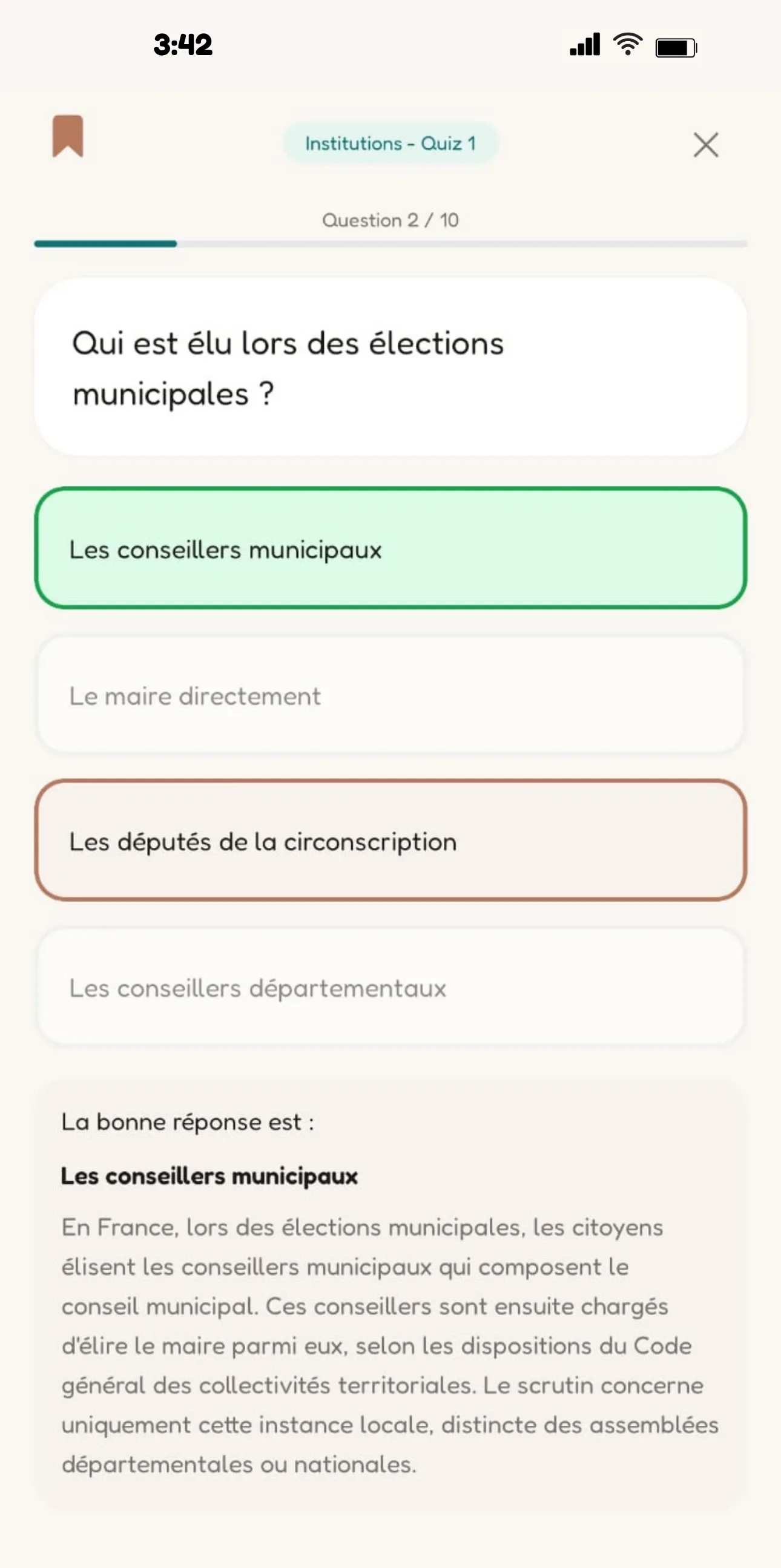

Free PDF of the questions
Would you rather study on paper? Download the free PDF: these 94 questions with their answers and explanations, ready to print, with no sign-up. To experience the actual exam format (40 questions in 45 minutes, timed), add some online practice under exam conditions.
To understand the full process of the exam (registration, price, topics), read the complete guide to the civic exam (examen civique) 2026.
Official resources
- Official list of knowledge questions — multi-year residence permit (carte de séjour pluriannuelle)
- Official list of knowledge questions — resident card (carte de résident)
- Citizen's Handbook (Livret du citoyen) 2026 (official PDF)
Citoyen is an independent app, not affiliated with the French Ministry of the Interior.
Frequently asked questions
Are these the questions from the official exam?
Yes: these are knowledge questions from the official lists published by the French Ministry of the Interior for the multi-year residence permit (carte de séjour pluriannuelle), resident card (carte de résident), and naturalisation. On exam day, 28 out of 40 questions are knowledge questions and 12 are real-life scenarios (mises en situation).
How many correct answers do you need to pass?
You need at least 32 correct answers out of 40, that’s 80%. The exam lasts 45 minutes.
Do the questions change depending on the procedure?
Yes. The format is the same, but the list of questions depends on your procedure: multi-year residence permit (carte de séjour pluriannuelle), resident card (carte de résident), or naturalisation.
Is there a PDF of the questions?
The Ministry publishes the official lists online. For practice, instant corrections and a timer prepare you much better for the exam format than a simple PDF.