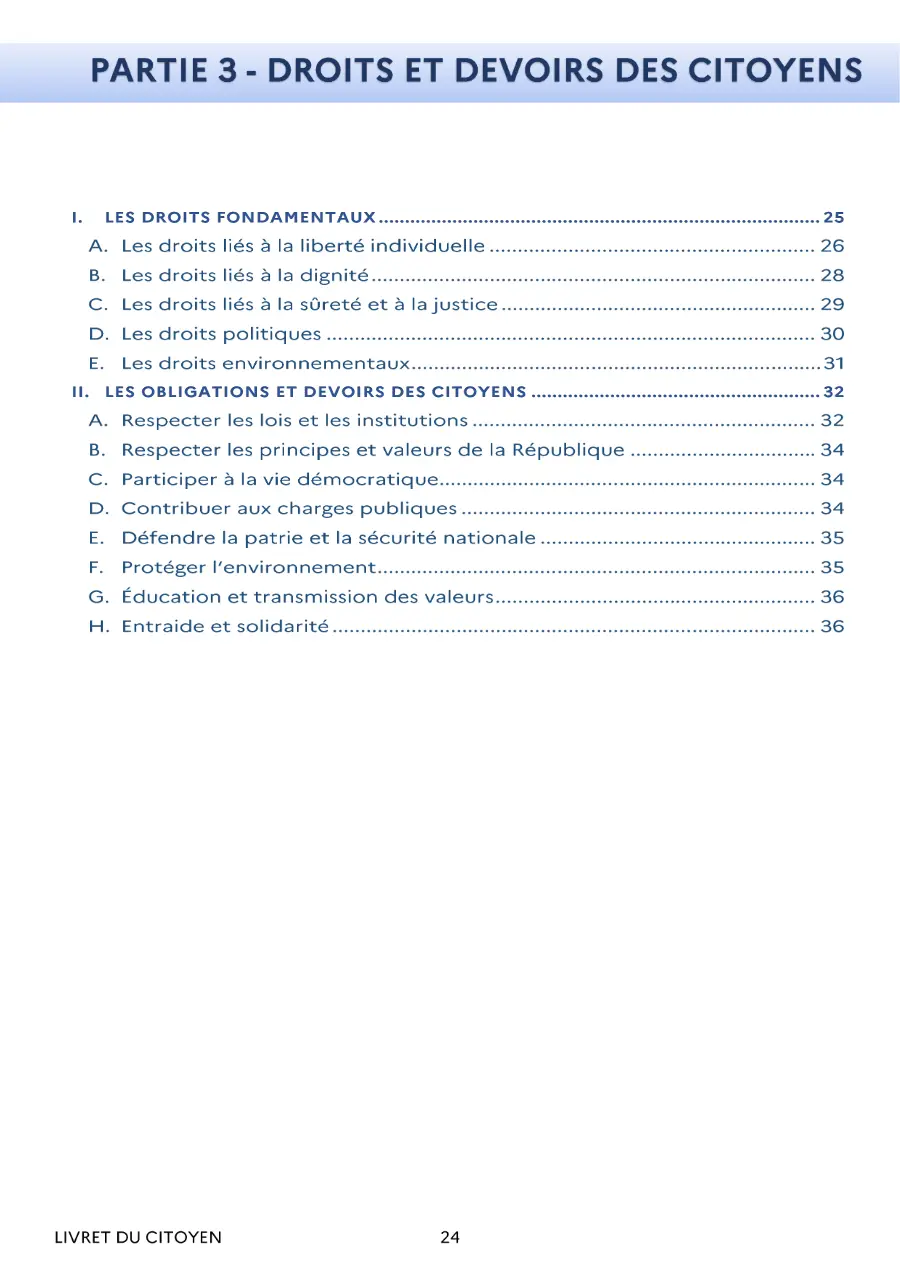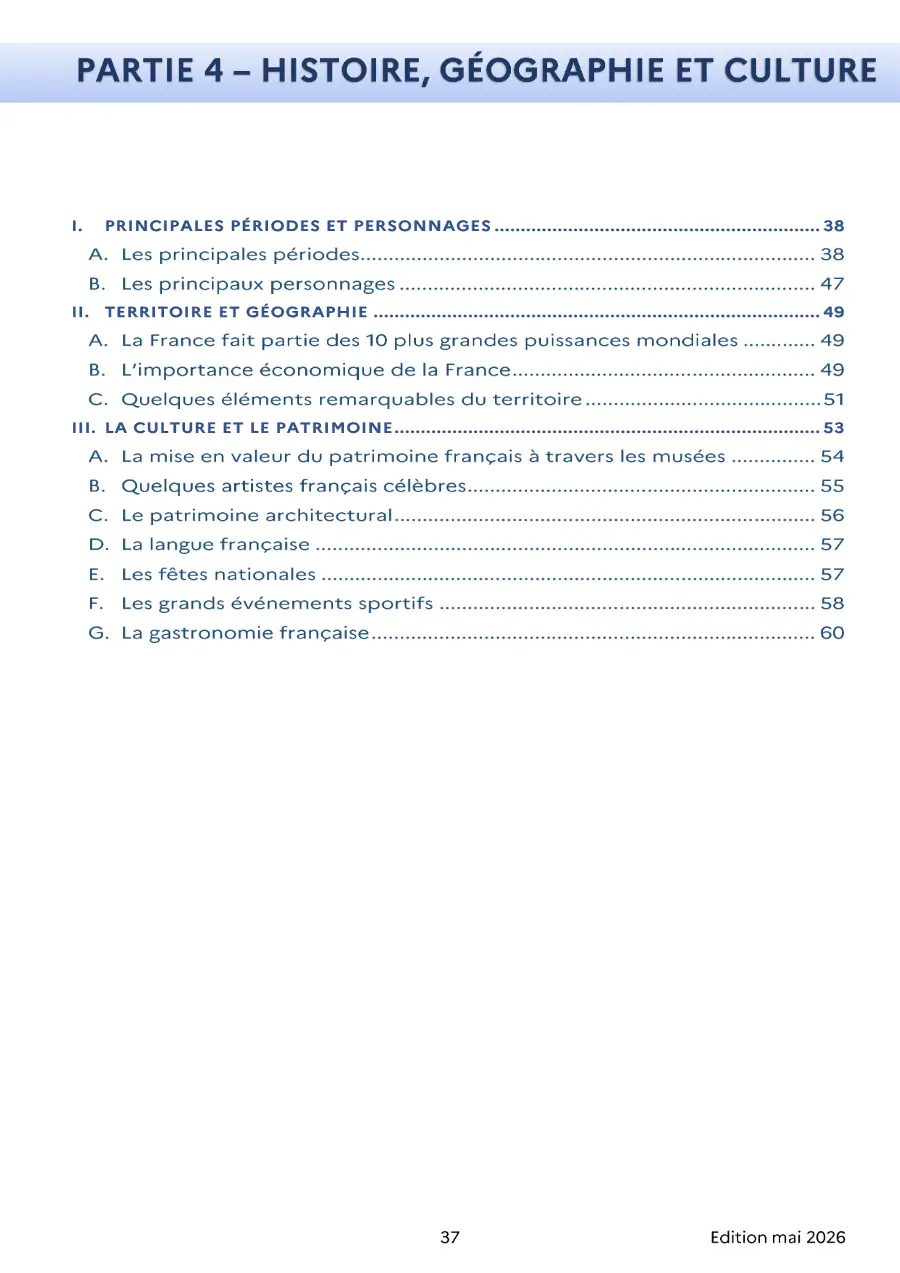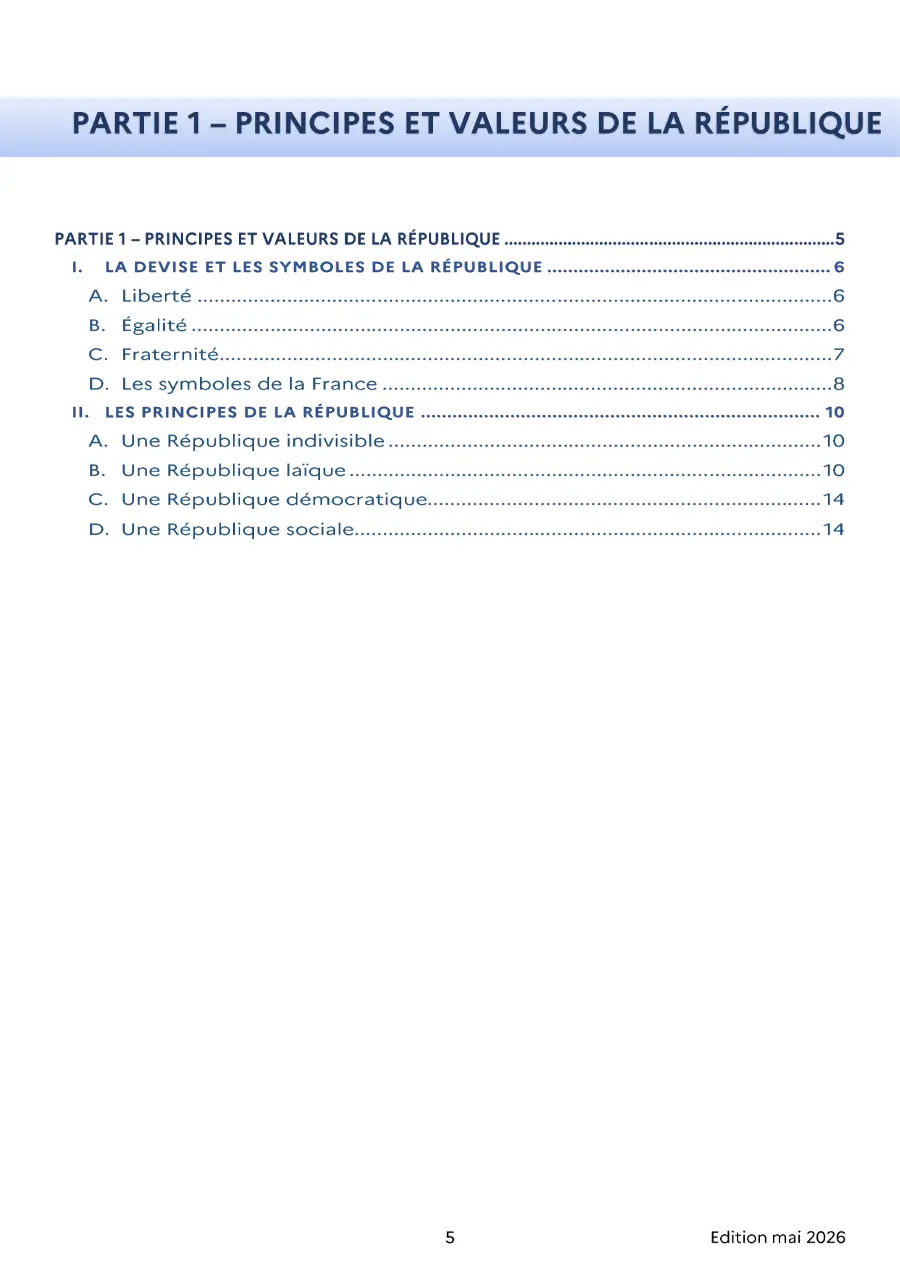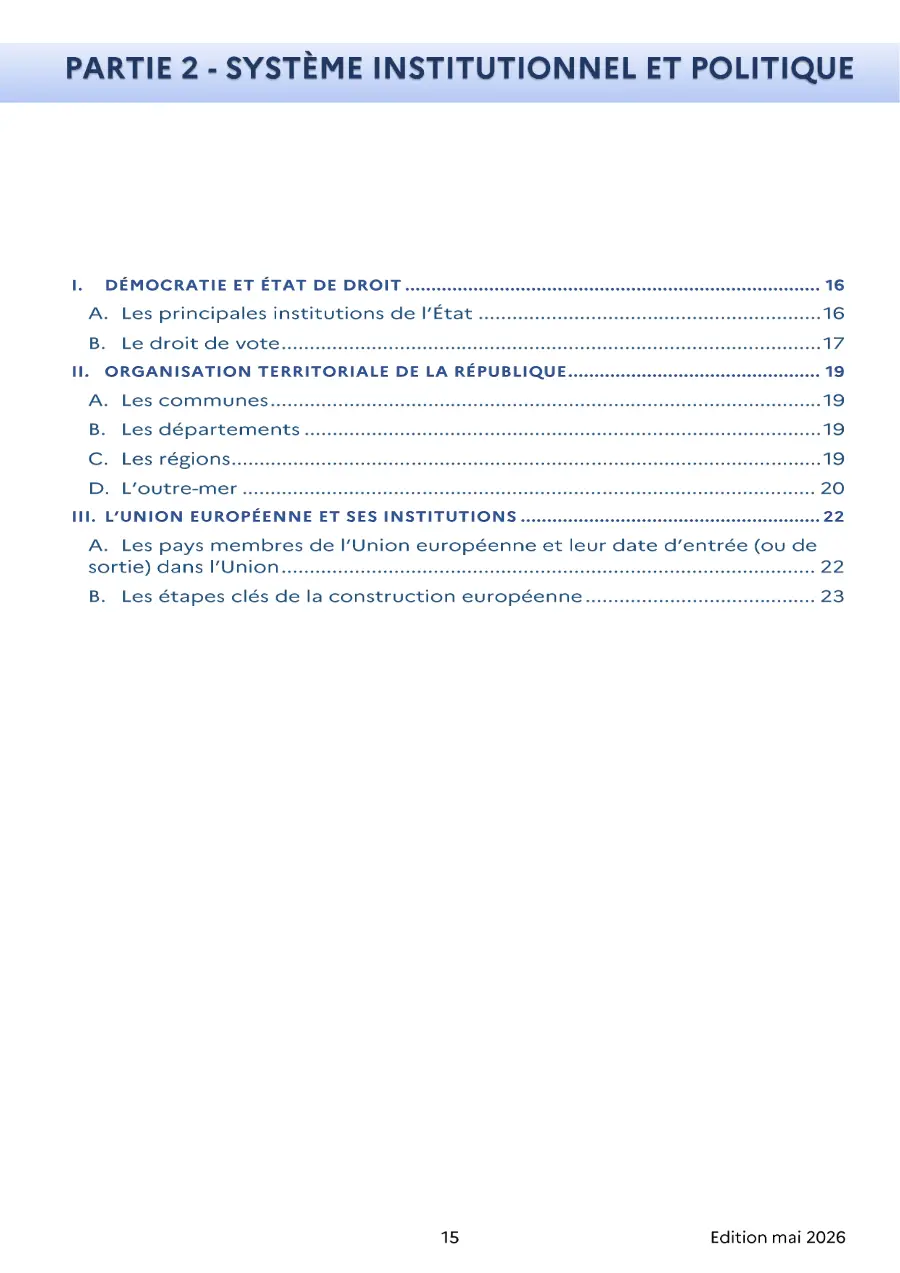
Key points
- The President of the Republic is elected by direct universal suffrage for 5 years and may be re-elected once. The President appoints the Prime Minister, who leads the Government's work.
- Parliament passes laws and scrutinises the Government: 577 members of the National Assembly elected by direct suffrage for 5 years, and 348 senators elected by indirect suffrage for 6 years.
- To vote, you must have French nationality (or the nationality of an EU country for local and European elections), be 18, not have been deprived of your civic rights, and be registered on the electoral roll.
- Women gained the right to vote in April 1944 and voted for the first time in April 1945.
- France has 34 875 communes, 101 departments, 18 regions and 12 overseas territories. It is one of the 6 founding countries of European integration; the Union has 27 member states.
Part 2 of the Citizen’s Handbook (pages 15 to 23) explains how France is governed: its institutions, voting rights, how the territory is organised, and France’s place in the European Union. It corresponds to the “Institutions” topic of the civic exam. This summary follows the order of the handbook; if in doubt, the official handbook is the definitive source.
Democracy and the rule of law
France is a democracy and a state governed by the rule of law: everyone must obey the law, including the state. Article 2 of the Constitution sets out the principle of the Republic: “government of the people, by the people and for the people”.
The current Constitution is that of the Fifth Republic, adopted in 1958 by referendum. It can be amended by referendum or by a vote of Parliament meeting in Congress. The Declaration of the Rights of Man and of the Citizen of 1789 is mentioned in its preamble.
The rule of law is based on the protection of fundamental freedoms, an independent justice system and the separation of the three branches of power:
| Power | Role | Who exercises it |
|---|---|---|
| Legislative | Drafting and passing laws | Members of the National Assembly and senators |
| Executive | Setting the Nation’s policy and enforcing laws | The Government |
| Judicial | Administering justice | Judges |
Political parties are free to form and operate. The administration complies with the Constitution, the laws and republican principles, under the supervision of the courts.
The main institutions
- The President of the Republic is the head of state and the armed forces. They are elected by direct universal suffrage for five years, renewable once. To stand as a candidate, you must obtain 500 endorsements from elected officials. The President appoints the Prime Minister and, on the Prime Minister’s proposal, the ministers, who come from the majority elected in the legislative elections.
- The Government, led by the Prime Minister, determines and conducts the Nation’s policy.
- Parliament is made up of the National Assembly and the Senate. It passes laws and oversees the Government. The 577 members of the National Assembly are elected by direct universal suffrage every five years; the 348 senators are elected by indirect universal suffrage for six years.
- The justice system is administered by judges. It settles disputes between individuals or businesses, and between citizens and the administration. It punishes offences with penalties set out by law, such as prison or a fine.
- The Constitutional Council checks that laws comply with the Constitution and ensures that national elections are conducted properly.
The right to vote
In France, suffrage is universal: all citizens can vote. The first vote by universal suffrage took place in 1848, but only men could vote. Women gained the right to vote in April 1944 and voted for the first time in April 1945.
To vote, you must:
- be a French national, or a national of an EU country for municipal and European elections;
- be an adult, which means being at least 18 years old;
- not have been deprived of your civil rights, a possible penalty for serious offences;
- be registered on the electoral roll, online or at the town hall.
Voting is personal and secret. At the polling station, you go into a polling booth to put your ballot paper in an envelope, then place it in the ballot box. You are not allowed to enter a polling booth with other people. During the campaign, each local authority puts up election posters on display boards: damaging them is forbidden. You must show proof of identity at the polling station, except in towns with fewer than 1 000 inhabitants, where the presiding officer may still ask you to prove your identity.
| Election | Who is elected | Term of office |
|---|---|---|
| Presidential | The President of the Republic | 5 years |
| Legislative | Members of the National Assembly | 5 years |
| Senatorial (by elected officials) | Senators | 6 years |
| Municipal | The municipal council, which runs the local authority with the mayor | 6 years |
| Departmental | Departmental councillors | 6 years |
| Regional | Regional councillors | 6 years |
| European | Members of the European Parliament | 5 years |
How local government is organised
Through decentralisation, the state gives powers and resources to local authorities: municipalities, departments, regions and overseas local authorities. In these areas, the state is represented by prefects for the region and department, or by high commissioners in some overseas local authorities.
| Level | Number | Who leads it | What it is responsible for |
|---|---|---|---|
| Municipality | 34 875 as at 1 January 2025 | The mayor and municipal council, elected for 6 years | Public nursery and primary schools, sport and culture, municipal roads, civil registration (births, marriages, deaths) |
| Department | 101, including 96 in mainland France and 5 overseas | The departmental council | Public secondary schools, social services, departmental roads, child protection, support for older people |
| Region | 18: 13 in mainland France and 5 overseas | The regional council | Public transport, economic development, vocational training, public upper secondary schools |
Municipalities also join together to form inter-municipal authorities (communities of municipalities, metropolitan authorities), which manage services such as water, sanitation, waste and urban transport. The most recent department is Mayotte, created in 2011. EU citizens can vote and stand in municipal elections.
Overseas France
France has 12 overseas territories:
- 5 are both departments and regions: Guadeloupe, Martinique, French Guiana, Réunion and Mayotte;
- 7 are local authorities with special status: New Caledonia, French Polynesia, Saint-Martin, Saint-Barthélemy, Saint-Pierre-et-Miquelon, the French Southern and Antarctic Lands, and Wallis and Futuna.
Martinique, Guadeloupe, Saint-Martin and Saint-Barthélemy make up the French West Indies. The handbook then shows the administrative map of France (page 21).
The European Union
France is one of the countries that helped to build the European project. After the European Coal and Steel Community (ECSC, 1951), the Treaty of Rome of 1957 established the European Economic Community between six founding countries: France, Germany, Italy, Belgium, the Netherlands and Luxembourg. Its aim was to bring the peoples of Europe together and preserve peace after the Second World War. In 1992, the Maastricht Treaty created the European Union. It now has 27 member states, and the EU Charter of Fundamental Rights, adopted in 2000, guarantees people’s rights.
| Year | Countries joining (or leaving) |
|---|---|
| 1957 | France, Germany, Italy, Belgium, the Netherlands, Luxembourg (6 founding countries) |
| 1973 | United Kingdom, Ireland, Denmark (9 members) |
| 1981 | Greece (10 members) |
| 1986 | Spain, Portugal (12 members) |
| 1990 | Extension to the former GDR following German reunification |
| 1995 | Austria, Sweden, Finland (15 members) |
| 2004 | Poland, Czech Republic, Hungary, Slovakia, Slovenia, Latvia, Lithuania, Estonia, Malta, Cyprus (25 members) |
| 2007 | Romania, Bulgaria (27 members) |
| 2013 | Croatia (28 members) |
| 2020 | The United Kingdom leaves the Union (Brexit): 27 members |
Other things to know about Europe:
- Since 1992, French citizens have also been European citizens. Every five years, they elect members of the European Parliament, which meets in Strasbourg.
- European citizens can travel, work, study and settle freely in other EU countries, and vote in local elections there.
- The European flag has 12 stars. The anthem is “Ode to Joy”, an excerpt from Beethoven’s Ninth Symphony, adopted in 1985. The motto is “United in diversity”.
- Euro coins and banknotes have been in circulation since 1 January 2002. France now shares this currency with 20 other EU countries.
- Europe Day is celebrated on 9 May, in memory of Robert Schuman’s declaration of 9 May 1950, considered the founding act of the European Union.
- The European Commission, the Union’s executive body, has been based in Brussels since 1958; the European Central Bank has been in Frankfurt since 1998.
Read these pages in the handbook
This summary follows Part 2 of the Livret du citoyen, pages 15 to 23 of the May 2026 edition. Only the official handbook is authoritative: open a chapter to read the actual pages.
- Democracy and the rule of lawpages 15 to 18
- Territorial organisation of the Republicpages 19 to 21
- The European Union and its institutionspages 22 to 23
Practise for free
Frequently asked questions
How many members of the National Assembly and senators are there?
577 members of the National Assembly, elected by universal direct suffrage every five years in parliamentary elections, and 348 senators, elected by universal indirect suffrage for six years. Together, they make up Parliament.
Can a foreign national vote in France?
According to the handbook, you must have French nationality to vote. Nationals of an EU country can vote in local and European elections. Other foreign nationals cannot vote.
How many countries are in the European Union?
27 member states since the United Kingdom left (Brexit) in 2020. The six founding countries of 1957 are France, Germany, Italy, Belgium, the Netherlands and Luxembourg.
Official sources
- French Ministry of the Interior — Citizen's Handbook, May 2026 edition (official PDF)
- Légifrance — Order (Arrêté) of 3 July 2026 concerning the Citizen's Handbook
- Légifrance — Order (Arrêté) of 10 October 2025 (civic exam syllabus)
This information does not replace that of the prefecture or the exam centre. Citoyen is an independent app, not affiliated with the French Ministry of the Interior.