Key points
- 14 July 1789: the storming of the Bastille and the start of the Revolution. The Declaration of the Rights of Man and of the Citizen dates from the same year.
- 1848: abolition of slavery (Victor Schoelcher). 1881-1882: free, secular and compulsory education (Jules Ferry). 1905: separation of the churches and the State.
- 18 June 1940: General de Gaulle's appeal. 6 June 1944: D-Day landings in Normandy. 8 May 1945: Germany's surrender.
- The Constitution of the Fifth Republic was adopted by referendum on 28 September 1958 and promulgated on 4 October 1958; Charles de Gaulle was its first president.
- France has a population of 68.6 million (2025), covers 675 000 km² and has 8 neighbouring countries. Mont Blanc (4 810 m) is its highest peak, and the Loire is its longest river.
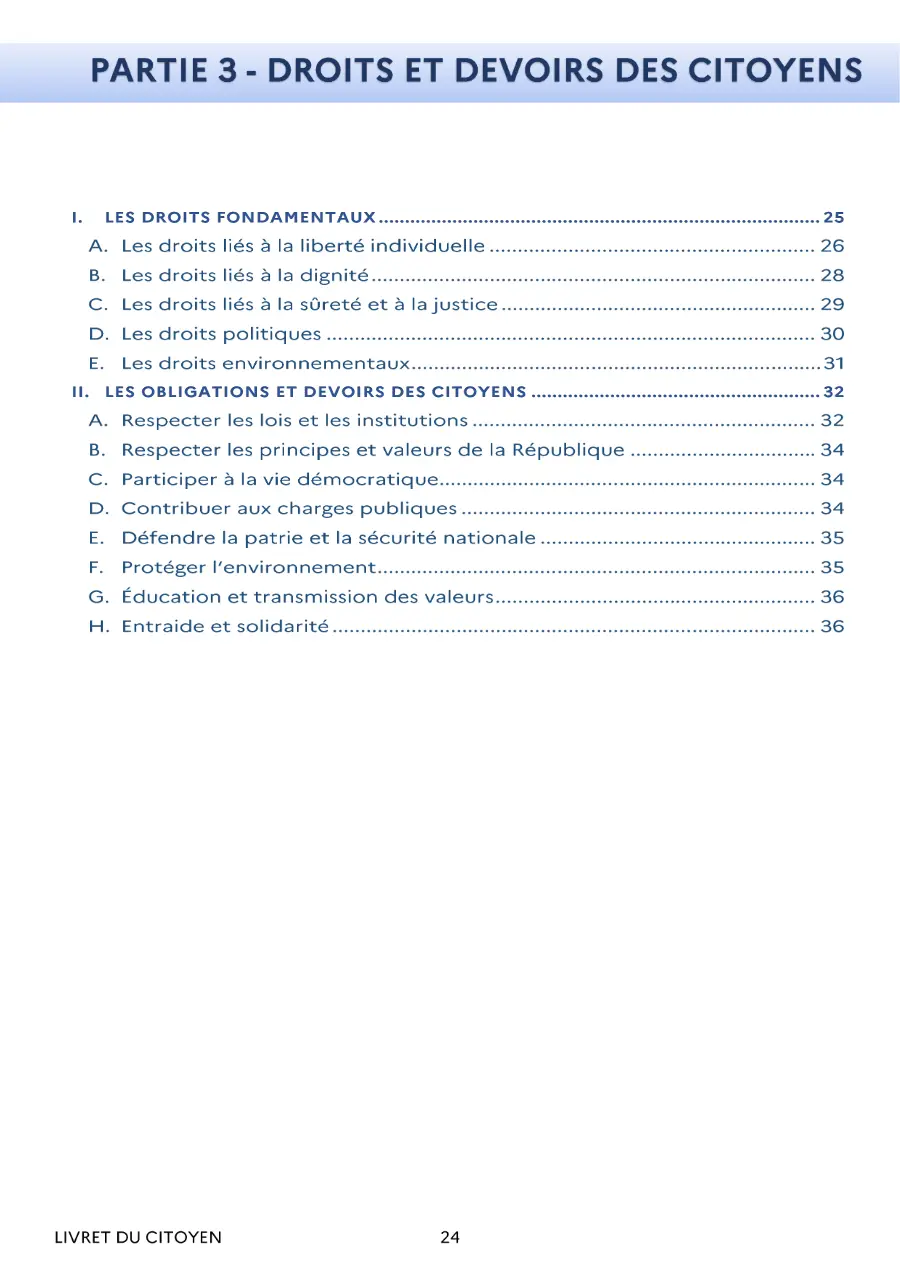
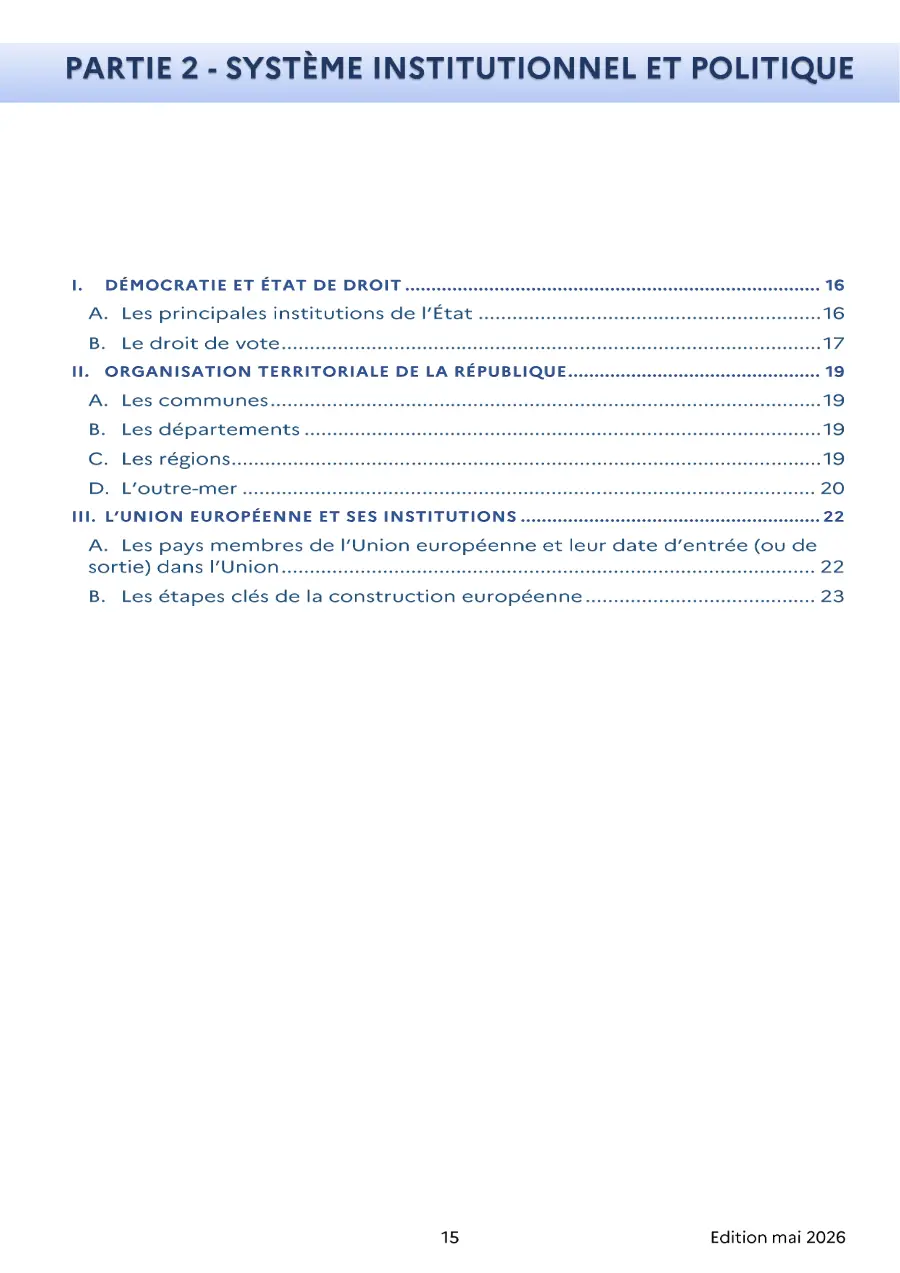
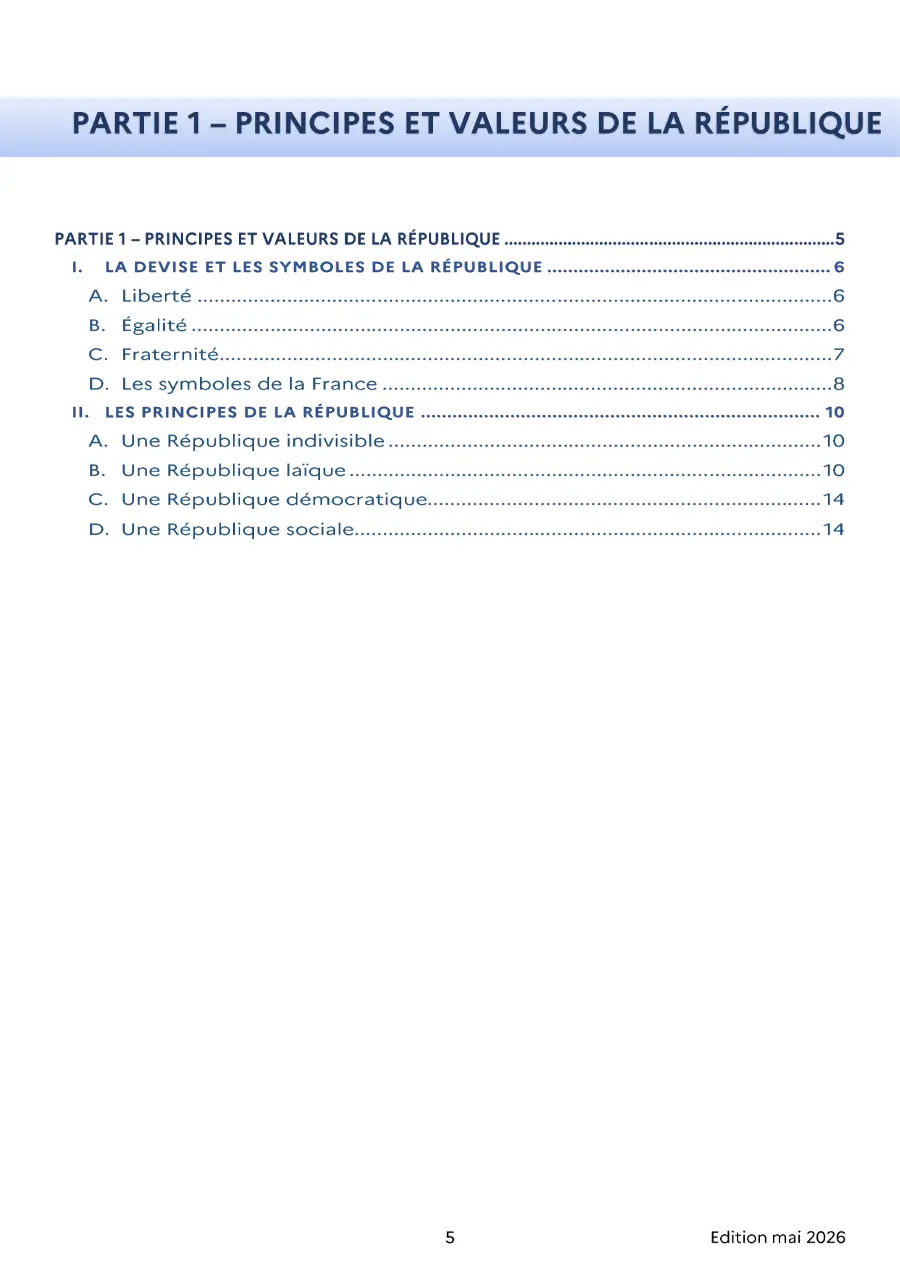
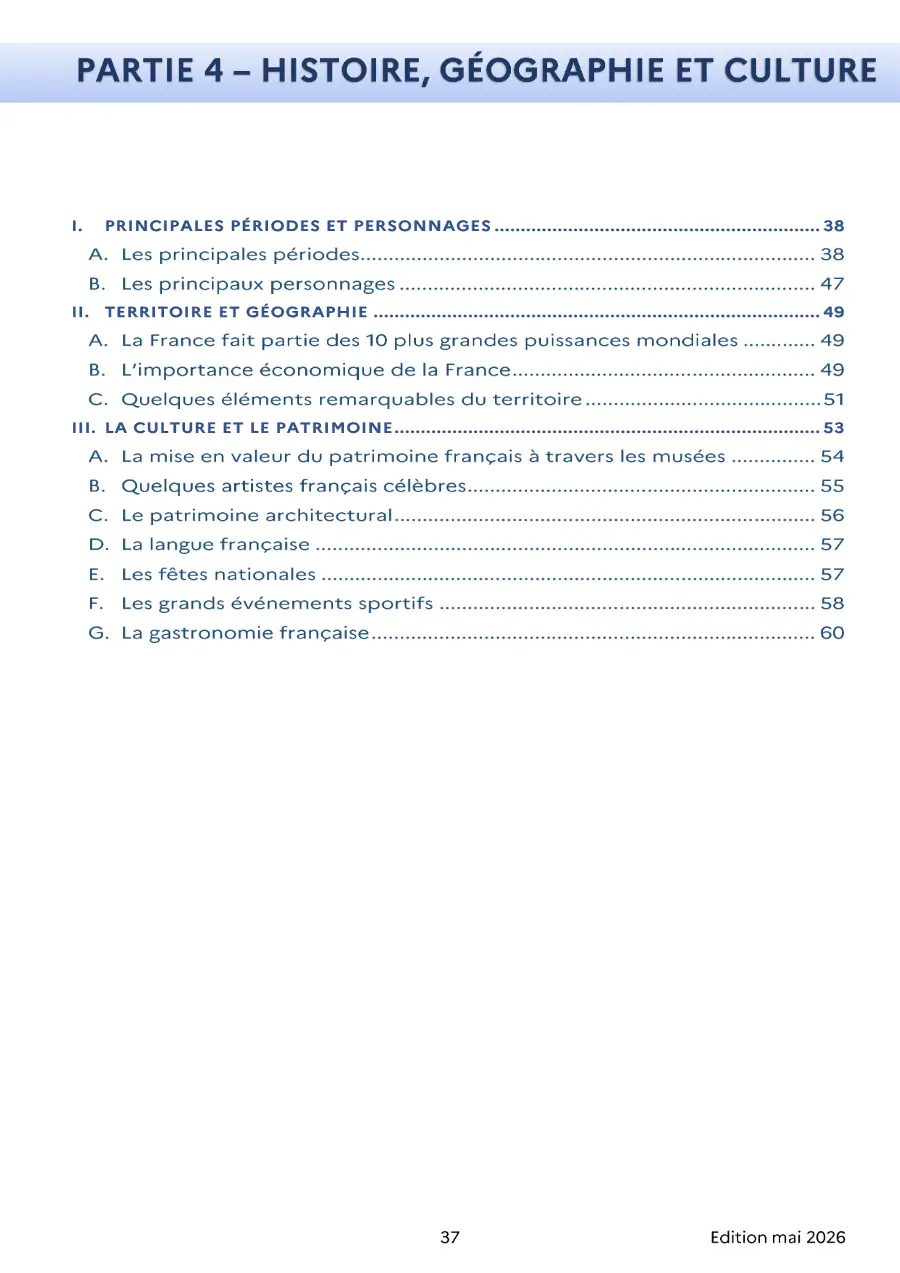
Part 4 of the Citizen’s Handbook (pages 37 to 60) is the longest: it covers the main stages in French history, the territory and the economy, then culture and heritage. It corresponds to the «History, geography and culture» topic in the civic exam. The handbook itself explains that it does not summarise all of French history, but presents its major stages. This summary follows its order; if in doubt, the official handbook is the definitive source.
The main periods in history
| Period | Dates |
|---|---|
| The Middle Ages | 476-1492 |
| The Ancien Régime | 1492-1789 |
| The French Revolution | 1789-1792 |
| The First Republic | 1792-1804 |
| The First Empire | 1804-1815 |
| The Bourbon Restoration and the July Monarchy | 1815-1848 |
| The Second Republic | 1848-1852 |
| The Second Empire | 1852-1870 |
| The Third Republic | 1870-1940 |
| The Vichy regime | 1940-1944 |
| The Provisional Government of the French Republic | 1944-1946 |
| The Fourth Republic | 1946-1958 |
| The Fifth Republic | Since 1958 |
From the Middle Ages to the Ancien Régime
- Clovis (466-511) united several Frankish kingdoms and adopted Christianity: an important step towards the unity of the territory.
- Joan of Arc (1412-1431), a young peasant woman, led French troops during the Hundred Years’ War against England. She became a national heroine.
- Under the Ancien Régime, the king held all the power (absolute monarchy) and was crowned at Reims. Henri IV signed the Edict of Nantes in 1598, which ended the religious wars between Catholics and Protestants. Louis XIV, the «Sun King», ruled from 1643 to 1715 and had the Palace of Versailles built. Molière wrote his comedies during this period («The Miser», «The Bourgeois Gentleman»).
- The Enlightenment philosophers (Voltaire, Diderot, Rousseau, Montesquieu, Condorcet, d’Alembert) defended tolerance, freedom of thought and opposition to arbitrary rule. Their ideas inspired the Revolution; Montesquieu spoke out against slavery.
The Revolution and the First Republic
On 14 July 1789, Parisians stormed the Bastille, a royal prison and symbol of arbitrary power: this marked the start of the Revolution and the end of absolute monarchy. The Declaration of the Rights of Man and of the Citizen (Déclaration des droits de l’homme et du citoyen) was adopted in 1789, with contributions from the Marquis de La Fayette. In 1791, a constitutional monarchy limited the king’s powers. Louis XVI was overthrown on 10 August 1792, then guillotined in Place de la Concorde in 1793.
The First Republic (Première République) began in 1792. Faced with revolts and wars, the government introduced the Reign of Terror (la Terreur), led in particular by Maximilien Robespierre. In 1799, Napoléon Bonaparte seized power.
The First Empire
Napoléon Bonaparte became emperor in 1804. He created the Civil Code (Code civil), the Bank of France and the prefects (préfets), waged many wars in Europe and controlled the press. He reinstated slavery in 1802, then abolished the slave trade in 1815. After his defeat at Waterloo in 1815, he abdicated.
From monarchies to the Second Empire
The monarchy returned with Louis XVIII in 1815 (the Restoration), followed by Charles X in 1824. After the Paris revolt of 1830, Louis-Philippe’s July Monarchy (Monarchie de Juillet) gave Parliament more power, but voting remained limited to the wealthiest. A new revolution broke out in 1848.
The Second Republic (1848-1852) was marked by the abolition of slavery in 1848, under a decree drafted by Victor Schoelcher. Since the XVIIth century, the slave trade had deported 1.2 million Africans to the West Indies, Réunion and French Guiana; Nantes was the main French port for this trade. Since the Taubira Law of 2001, France has recognised the slave trade and slavery as crimes against humanity, and 10 May is the national day of remembrance. At the same time, Victor Hugo (“Les Misérables”, “The Hunchback of Notre-Dame”) spoke out against inequality and the death penalty.
Louis-Napoléon Bonaparte, Napoléon I’s nephew, staged a coup in December 1851 and became Napoléon III in 1852. The Second Empire modernised the economy and came to an end in 1870, after defeat by Prussia.
The Third Republic and the two world wars
The Third Republic (Troisième République) established the Republic on a lasting basis. The Jules Ferry laws (lois de Jules Ferry) made public education free in 1881, then secular and compulsory in 1882. The major laws on freedom date from this period: freedom of the press (29 July 1881), trade unions (21 March 1884), freedom of association (1 July 1901) and the separation of Church and State (séparation des Églises et de l’État) (9 December 1905).
- The First World War (1914-1918) ended with the armistice of 11 November 1918 and the victory of France, led by Georges Clemenceau, and its allies. It caused 10 million deaths, including 1.45 million French people. The Treaty of Versailles (28 June 1919) provided for the League of Nations, which inspired the UN. 11 November is a public holiday.
- The Second World War (1939-1945) was started by Adolf Hitler. France was invaded in 1940, then fully occupied from 1942. The Nazis exterminated millions of Jews (the Shoah), thousands of Roma, gay people and people with disabilities. The war caused more than 50 million deaths.
Vichy, the Resistance and the Liberation
After the defeat, Marshal Pétain established an authoritarian regime in Vichy that collaborated with Nazi Germany and bore some responsibility for the deportation of Jews. The Resistance (Résistance) was united under the leadership of Jean Moulin, sent by General de Gaulle, leader of Free France. His appeal of 18 June 1940 on London radio (BBC) marked the beginning of the Resistance.
The Liberation began with the Allied landings in Normandy on 6 June 1944. Paris was liberated on 25 August 1944. Germany surrendered on 8 May 1945, which is now a public holiday. De Gaulle led the government until January 1946. The Fourth Republic (Quatrième République) (1946-1958) then suffered from government instability.
The Fifth Republic
Faced with the Algerian War and this instability, de Gaulle was recalled to power in 1958 to draft a new Constitution. It was adopted by referendum on 28 September 1958 and promulgated on 4 October 1958. It gives the president strong executive powers. De Gaulle was the first president of the Fifth Republic, which is still France’s system of government.
- Decolonisation: most colonies gain their independence in the 1950s and 1960s through negotiations, but two wars break out, in Indochina (1946-1954) and Algeria (1954-1962).
- May 1968: a movement started by students, then joined by workers and trade unions, leads to some of the biggest strikes of the twentieth century and social advances, such as an increase in the minimum wage.
- 1974: the age of majority is lowered from 21 to 18 years, under Valéry Giscard d’Estaing.
- 1975: the Veil Law (loi Veil), championed by Simone Veil, decriminalises abortion, following the Neuwirth Law of 1967, which had authorised the contraceptive pill.
- 1981: the death penalty is abolished, championed by Robert Badinter, Minister of Justice under François Mitterrand.
- 2013: the law of 17 May 2013, championed by Christiane Taubira, opens up marriage and adoption to same-sex couples.
Presidents of the Fifth Republic
| President | Elected in |
|---|---|
| Charles de Gaulle | 1959 |
| Georges Pompidou | 1969 (the only president to die in office, in 1974) |
| Valéry Giscard d’Estaing | 1974 |
| François Mitterrand | 1981, re-elected in 1988 |
| Jacques Chirac | 1995, re-elected in 2002 |
| Nicolas Sarkozy | 2007 |
| François Hollande | 2012 |
| Emmanuel Macron | 2017, re-elected in 2022 |
If the president dies in office, the President of the Senate (président du Sénat) replaces them until an election is held at short notice.
Naturalised public figures
The handbook mentions people who became French citizens and helped raise France’s profile, including Marie Curie, born in Poland (Nobel Prize in Physics in 1903 and Chemistry in 1911, buried in the Panthéon), Joséphine Baker, of American origin, who joined the Resistance, Léon Gambetta, one of the founders of the Third Republic, Marguerite Yourcenar, the first woman elected to the Académie française, Romain Gary, the only writer to have received the Prix Goncourt twice, physicist Georges Charpak (1992 Nobel Prize), painters Kandinsky and Chagall, poet Apollinaire, cyclist Maurice Garin, winner of the first Tour de France in 1903, as well as Dalida and Georges Moustaki.
Territory and geography
In 2025, France has 68.6 million inhabitants across 675 000 km², including mainland France and overseas territories. Mainland France has land borders with 8 countries: Germany, Andorra, Belgium, Spain, Italy, Luxembourg, Monaco and Switzerland. It has 5 500 km of coastline along the English Channel, the North Sea, the Atlantic Ocean and the Mediterranean Sea. The largest cities are Paris, Lyon, Lille, Marseille, Toulouse, Bordeaux, Nantes, Nice and Strasbourg.
- Around the world: France is one of the ten largest world powers. It is a permanent member of the UN Security Council, with the right of veto. The UN was created in 1945. France has embassies and consulates in more than 150 countries and is part of the European Union, NATO, the G7, the G20 and the International Organisation of La Francophonie.
- The economy: in 2024, France is the 7th largest economy in the world. Its areas of excellence include aeronautics and space (Ariane rockets are launched from Kourou, in French Guiana), luxury and fashion, food and drink, energy, pharmaceuticals, digital technology and the automotive industry. Its major ports are Le Havre, Marseille-Fos, Dunkirk and Nantes-Saint-Nazaire. Thanks to its overseas territories, it is the 2nd largest maritime power in the world, behind the United States. It is also the European Union’s leading agricultural power.
- The mountains: the Alps, with Mont Blanc (4 810 m), the highest peak in France and Europe; the Pyrenees, the Massif Central, the Jura and the Vosges.
- The rivers: the Loire (the longest), the Seine (Paris), the Garonne (Toulouse, Bordeaux), the Rhône (Lyon) and the Rhine, which forms part of the border with Germany.
- Active volcanoes are found in the West Indies, Réunion and Mayotte. Piton de la Fournaise, on Réunion, is one of the world’s most active volcanoes.
- Forests cover 32 % of mainland France. France’s largest forest is the Amazon rainforest, in French Guiana.
- Lascaux Cave, in Dordogne, preserves prehistoric paintings dating from 18 000 to 15 000 years before Christ.
Culture and heritage
France is the world’s leading tourist destination. Public museums, libraries and events such as the European Heritage Days (held in September, first created in France in 1984), the Avignon Festival and the Cannes Film Festival make culture accessible to everyone.
- Museums: France has more than 1 200. The Louvre, housed in a former royal palace and conceived from its opening in 1793 as a universal museum, displays Leonardo da Vinci’s Mona Lisa. The Musée d’Orsay, a former railway station built for the 1900 World’s Fair, has the world’s largest collection of Impressionist paintings.
- Artists: Rouget de Lisle (La Marseillaise), George Sand, Charles Baudelaire (“Les Fleurs du mal”), Paul Cézanne, Auguste Rodin (“The Thinker”), Claude Monet (“Impression, Sunrise”), Auguste Renoir, Claude Debussy, Suzanne Valadon, Simone de Beauvoir, Albert Camus, Marguerite Duras (“The Lover”) and Édith Piaf (“La Vie en rose”).
- Architectural heritage: the Eiffel Tower, built by Gustave Eiffel for the 1889 World’s Fair, Mont-Saint-Michel in Normandy and the Palace of the Popes in Avignon, both listed as UNESCO World Heritage Sites.
- French is the 4th most widely spoken language in the world, with more than 300 million speakers, and the official language of more than 30 countries. The International Organisation of La Francophonie brings together 93 states and governments.
- Festivals and celebrations: 14 July, with the military parade on the Champs-Élysées; 1 May, Labour Day (a public holiday since 1947, when people give lily of the valley); and the Fête de la musique on 21 June, celebrated since 1982.
- Sport: the Tour de France (held every year in July since 1903), victories in the FIFA World Cup in 1998 against Brazil and in 2018 against Croatia, and the Paris 2024 Olympic and Paralympic Games, a century after the 1924 Games.
- Food: the gastronomic meal of the French is listed as UNESCO Intangible Cultural Heritage. The handbook mentions wine and champagne, dishes such as pot-au-feu, blanquette de veau and boeuf bourguignon, and cheeses such as brocciu (Corsica), camembert (Normandy) and maroilles (the Nord region).
Read these pages in the handbook
This summary follows Part 4 of the Livret du citoyen, pages 37 to 60 of the May 2026 edition. Only the official handbook is authoritative: open a chapter to read the actual pages.
- Main periods and figurespages 37 to 48
- Territory and geographypages 49 to 52
- Culture and heritagepages 53 to 60
Practise for free
Frequently asked questions
Which dates in French history should you know for the civic exam?
The handbook highlights, in particular, 1789 (Revolution and Declaration of the Rights of Man and of the Citizen), 1804 (Civil Code and First Empire), 1848 (abolition of slavery), 1881-1882 (Jules Ferry laws), 1905 (secularism), 1914-1918 and 1939-1945 (world wars), 1944 (women's right to vote), 1958 (Fifth Republic), 1974 (voting age lowered to 18), 1975 (Veil law), 1981 (abolition of the death penalty) and 2013 (marriage for all).
Which countries share a land border with metropolitan France?
Eight countries: Germany, Andorra, Belgium, Spain, Italy, Luxembourg, Monaco and Switzerland.
Who are the presidents of the Fifth Republic?
Charles de Gaulle (1959), Georges Pompidou (1969), Valéry Giscard d'Estaing (1974), François Mitterrand (1981, re-elected in 1988), Jacques Chirac (1995, re-elected in 2002), Nicolas Sarkozy (2007), François Hollande (2012) and Emmanuel Macron (2017, re-elected in 2022).
Official sources
- French Ministry of the Interior — Citizen's Handbook, May 2026 edition (official PDF)
- Légifrance — Order of 3 July 2026 concerning the Citizen's Handbook
- Légifrance — Order of 10 October 2025 (civic exam syllabus)
This information does not replace that of the prefecture or the exam centre. Citoyen is an independent app, not affiliated with the French Ministry of the Interior.