Key points
- The motto “Liberty, Equality, Fraternity” is displayed on the front of public buildings, such as town halls and prefectures.
- The symbols of France: 14 July (national day since 1880), La Marseillaise (Rouget de Lisle, 1792), the blue, white and red flag, Marianne and the French language. The cockerel has no official status.
- Article 1 of the 1958 Constitution: “France is an indivisible, secular, democratic and social Republic”.
- Secularism guarantees the freedom to believe or not to believe and requires the state to remain neutral (1905 law). It is celebrated on 9 December.
- Public officials must remain neutral; users of public services may wear a religious symbol. At state schools, conspicuous religious symbols are banned (law of 15 March 2004).
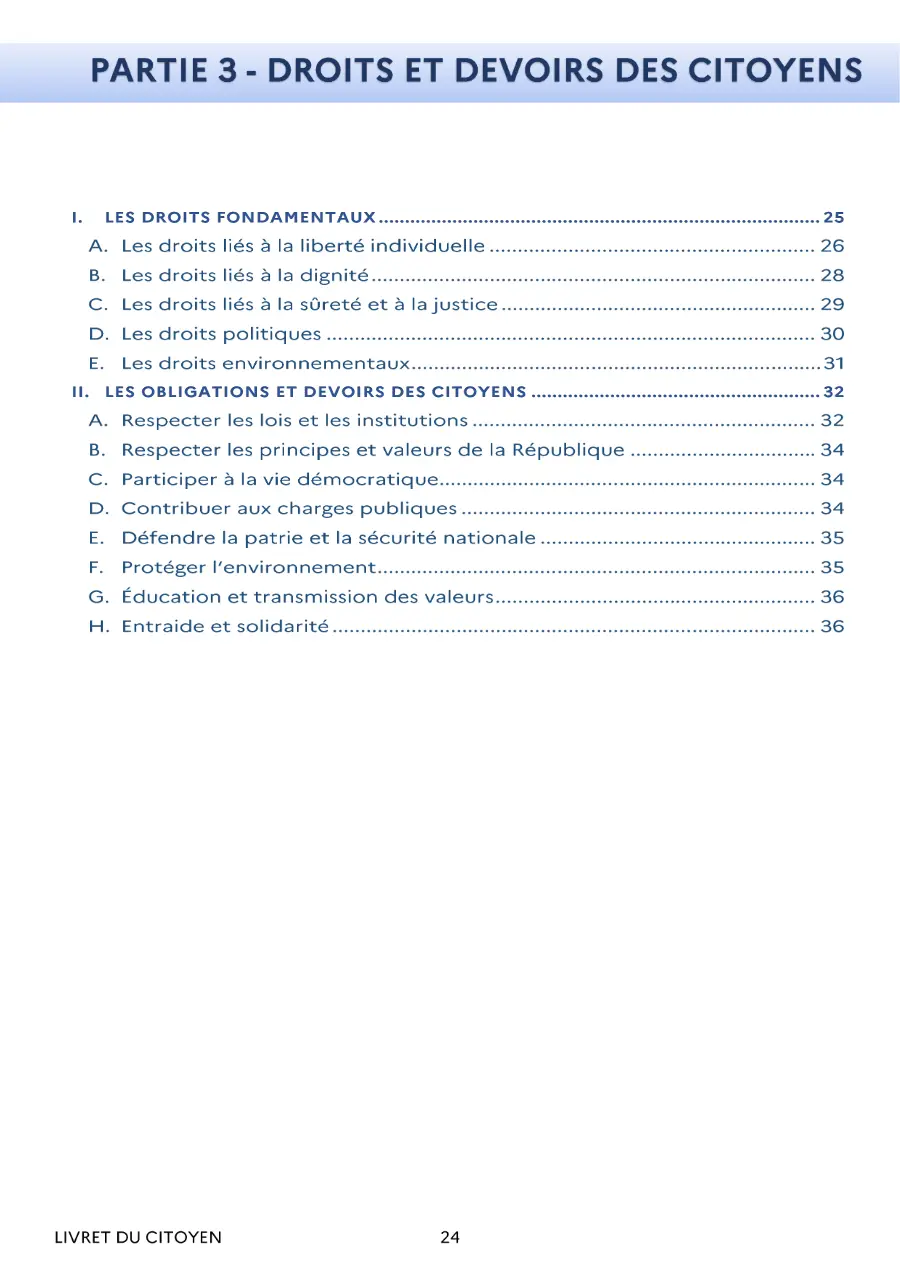
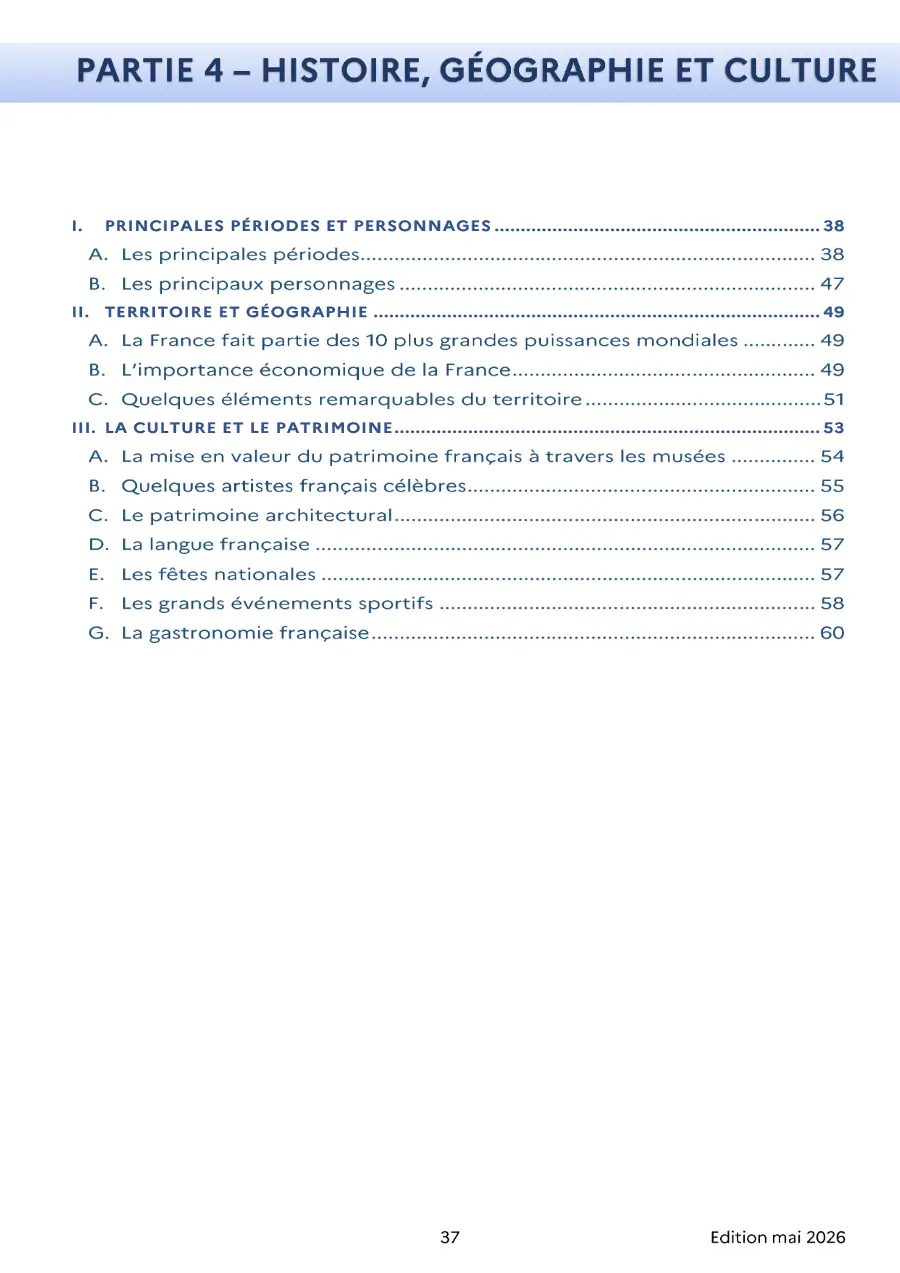
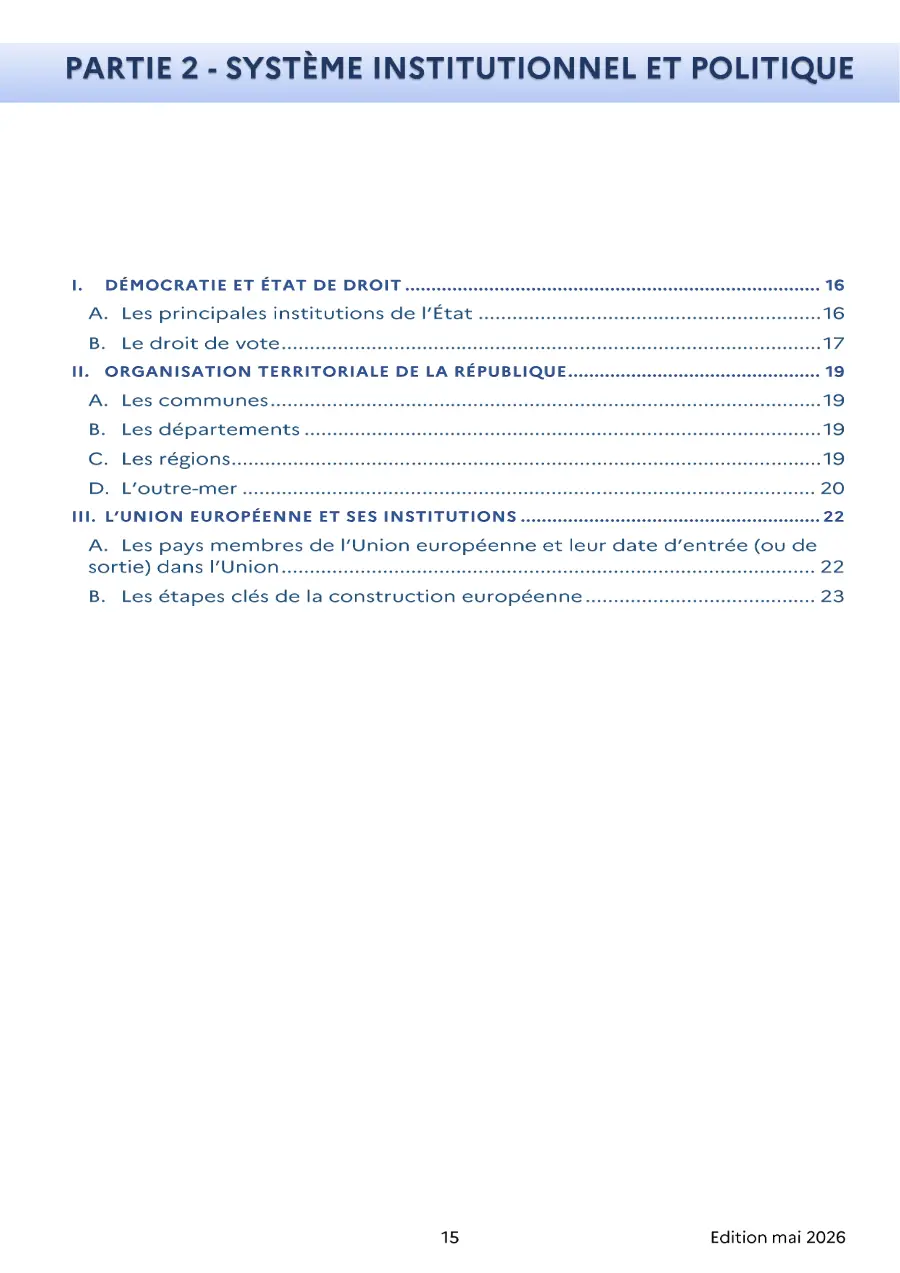
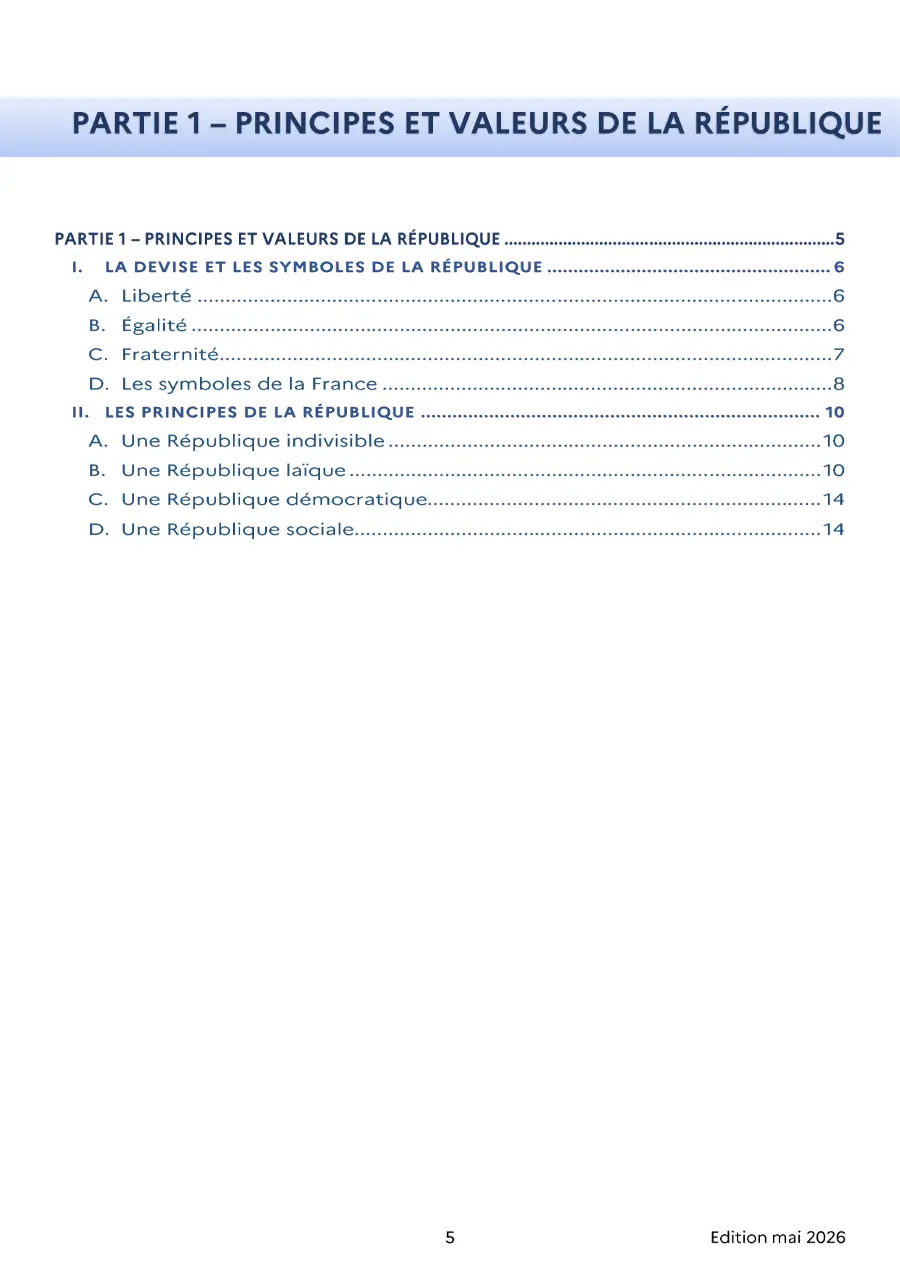
Part 1 of the Citizen’s Handbook (Livret du citoyen) (pages 5 to 14) explains what underpins the Republic: its motto, its symbols and the principles set out in the Constitution. It corresponds to the first topic of the civic exam. This summary follows the order of the handbook and includes its examples; if in doubt, the official handbook takes precedence.
The motto: Liberty, Equality, Fraternity
France’s motto upholds the founding values of the Republic. It is displayed on the front of public buildings, such as prefectures and town halls.
Liberty
Women and men are free to make their own choices, hold their own opinions, and think, express themselves and live as they wish. The 1789 Declaration of the Rights of Man and of the Citizen (DDHC) states in Article 4: “liberty consists in being able to do anything that does not harm others”. All citizens enjoy the same freedoms, in accordance with the law.
Equality
Equality is a fundamental principle, set out in Article 1 of the 1958 Constitution. All citizens have the same rights, whatever their sex, origin, religion, opinions or sexual orientation. Equality between women and men has been included in the preamble to the Constitution since 1946 and applies in all areas: work, health and education.
France condemns discrimination, which means treating one person differently from another in a comparable situation (housing, work, leisure) because of their origin, sex, sexual orientation, political opinion, age, religious beliefs or physical appearance. Discrimination is punishable by law. The state works in particular to combat sexism, racism, antisemitism, religious discrimination and anti-LGBT+ hatred. At work, every decision by an employer (recruitment, promotion) must be based on professional reasons, never personal ones.
Fraternity
France is founded on the will of its citizens to live together. Fraternity means seeing others as your equals despite your differences: it is civic, and not based on origin or religion. It is expressed through solidarity:
- Collective: the Nation protects everyone, for example through social security. Paying taxes funds public services for all, and every citizen must take part in defending the Nation if necessary.
- Between generations: by paying contributions, each employee helps fund pensions.
Organising a collection for a humanitarian charity or getting involved in a local association are examples of fraternity in everyday life.
The symbols of France
| Symbol | What the handbook says |
|---|---|
| Bastille Day | 14 July, a national holiday since 1880. It commemorates the storming of the Bastille (14 July 1789, the start of the Revolution) and the Festival of the Federation (14 July 1790). |
| The national anthem | La Marseillaise, written in 1792 by Rouget de Lisle. Children study it at primary school. The handbook includes its lyrics. |
| The official language | French. |
| Marianne | A woman wearing a Phrygian cap, a symbol of freedom. She appears on government documents, and her statue can be found in every town hall. |
| The flag | Blue, white and red, created during the Revolution. Official flag since 1794, except during the Restoration (1814-1830). |
| The cockerel | It represents pride, courage and vigilance. It has no official status in the Constitution, but is widely recognised as a national symbol. |
The four principles of the Republic
Article 1 of the Constitution of 4 October 1958 states that “France is an indivisible, secular, democratic and social Republic”. The Constitution is the set of fundamental rules that organise the country: it takes precedence over all laws, sets out citizens’ rights and freedoms, and divides powers between the government, Parliament and the courts.
An indivisible Republic
No individual or group can make decisions on behalf of all French people. Decisions are made by representatives elected by the people, or by the people themselves in a referendum. All French people, in mainland France and overseas, are subject to the same laws and have the same rights and duties: this is the unity of the Republic. The country has a single official language, French.
A secular Republic
Secularism has constitutional status and is commemorated every year on 9 December. It guarantees freedom of conscience: everyone is free to follow a religion, have no religion, change religion or stop following one. It also guarantees the freedom to practise one’s religion while respecting public order (Article 10 of the DDHC) and requires the State to remain neutral. An atheist does not believe in any religion; an agnostic is sceptical about religion.
- State neutrality: since the 1905 law, the Churches and the State have been separate. The State does not fund the construction of a place of worship or religious staff, except for historical exceptions in Alsace and Moselle. However, it may fund the restoration of a listed religious monument. The authorities treat everyone in the same way, whatever their religion.
- Proselytism, meaning trying to persuade someone to adopt your religion, is allowed as long as there is no violence, threat or pressure. It is prohibited in public services. Handing out religious leaflets in the street is allowed as long as it does not disturb public order.
- Blasphemy is not an offence: everyone may criticise or mock a religion, including through caricature. Freedom of expression has other limits: defamation and public insults, incitement to racial, ethnic or religious hatred, encouraging crimes against a religion, using religion to justify terrorism or war crimes, incitement to discrimination, and denial of crimes against humanity, such as the Holocaust.
| Where? | The rules of secularism |
|---|---|
| Public spaces (streets, parks, public transport) | Everyone can display their religion (headscarf, kippah, cross, turban). The law of 11 October 2010 prohibits covering your face (balaclava, mask, full-face veil). A religious gathering may be regulated or banned to prevent disturbances, for example street prayers. |
| Public services | Public officials remain neutral, and no religious, political or philosophical symbols are displayed on the premises. Service users may wear a religious symbol, but cannot demand that the service adapt to their religion. |
| Work | Public officials do not wear religious symbols or practise their religion at work. Private-sector employees may express their religion, unless this disrupts the business or for safety reasons; workplace rules may set justified limits. You must ask your employer for time off for a religious holiday, and they may refuse without discriminating. |
| State schools | Conspicuous religious symbols are prohibited (law of 15 March 2004); discreet symbols are allowed. You cannot refuse a lesson or a rule in the name of your religion. The Charter of Secularism in Schools (Charte de la laïcité à l’École) is addressed to pupils, parents and staff. |
A democratic Republic
Sovereignty belongs to the people. Article 3 of the Constitution states: “National sovereignty belongs to the people, who exercise it through their representatives and by referendum”. The President of the Republic, members of parliament, mayors and elected representatives in the regions, departments and municipalities are elected by direct or indirect universal suffrage. All citizens aged 18 or over who have their civil and political rights can vote and stand for election.
In direct universal suffrage, citizens elect their representatives themselves. In indirect universal suffrage, elected representatives vote in turn.
A social Republic
This principle follows from equality: “Men are born and remain free and equal in rights” (Article 1 of the DDHC). To make this equality real, the State promotes equal opportunities and supports the most vulnerable, particularly in four areas:
- education, with free schooling;
- housing, with social housing;
- employment, with the active solidarity income and help to return to work;
- health, with Social Security.
Read these pages in the handbook
This summary follows Part 1 of the Livret du citoyen, pages 5 to 14 of the May 2026 edition. Only the official handbook is authoritative: open a chapter to read the actual pages.
The official questions on “Principles and values”Practise for free
Frequently asked questions
Is the cockerel an official symbol of France?
No. The Citizen's Handbook (Livret du citoyen) states that the cockerel has no official status under the Constitution, but that it is widely recognised as a national symbol. The official symbols are the tricolour flag, La Marseillaise, the motto, the national day of 14 July, Marianne and the French language.
Can you wear a religious symbol in a town hall?
Yes, if you are there as a user of the service, as long as you follow the rules for how the service operates. No, if you work there: public officials must remain neutral and cannot show their religion while at work.
Is blasphemy banned in France?
No. Blasphemy is not an offence: anyone can criticise or make fun of a religion, including through cartoons. Freedom of expression has other limits, such as defamation, incitement to hatred or denial of crimes against humanity.
Official sources
- French Ministry of the Interior — Citizen's Handbook (Livret du citoyen), May 2026 edition (official PDF)
- Légifrance — Order of 3 July 2026 on the Citizen's Handbook (Livret du citoyen)
- Légifrance — Order of 10 October 2025 (civic exam syllabus)
This information does not replace that of the prefecture or the exam centre. Citoyen is an independent app, not affiliated with the French Ministry of the Interior.